ABS Wire Harness Symptoms: Diagnosis and Repair Guide
Home » ABS Wire Harness Symptoms: Diagnosis and Repair Guide
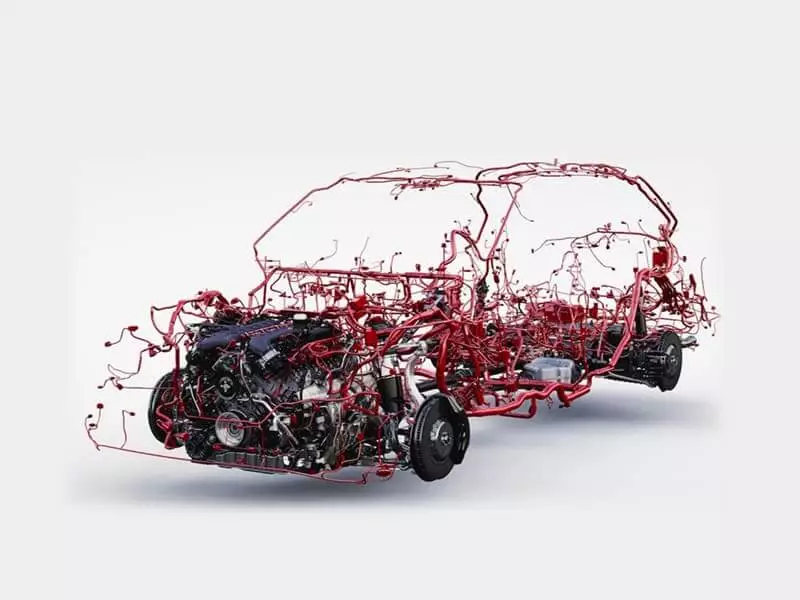
When the ABS system malfunctions, you might first think of the wheel speed sensors, the ABS control module, or the braking system. However, the ABS wire harness is often overlooked. The wire harness is responsible for transmitting power and signals between the wheel speed sensors, the ABS control module, and the vehicle’s electrical system. If an open circuit, short circuit, poor connection, or damaged insulation occurs, the ABS warning light may illuminate.
Proper diagnosis should begin with the symptoms of the malfunction to verify that the electrical connections between the ABS sensors → connectors → ABS wire harness → vehicle wiring → ABS control module are functioning correctly.
This guide will help you quickly diagnose ABS wire harness faults by covering common symptoms, safety assessments, and decisions regarding repair or replacement.
What Are the Most Common Signs of an ABS Harness Fault?
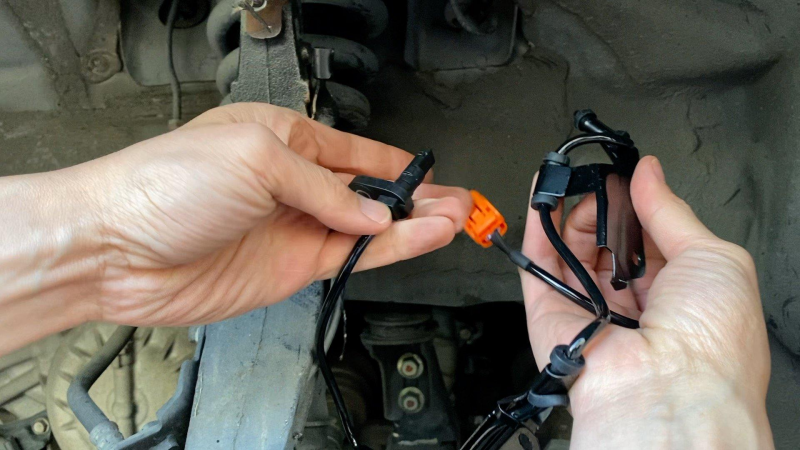
The ABS harness is responsible for transmitting power and signals between the wheel speed sensors and the ABS/ESC control module. It’s important to note that you shouldn’t assume the harness is damaged based solely on the symptoms. Similar issues can be caused by the wheel speed sensors, wheel hub bearings, magnetic encoder rings, installation clearance, connectors, or the ABS/ESC module itself.
During actual diagnosis, you need to combine the following steps: “Symptoms → Trouble Codes → Real-time Wheel Speed Data → Harness Inspection.”
ABS, traction-control, and stability-control warning lights
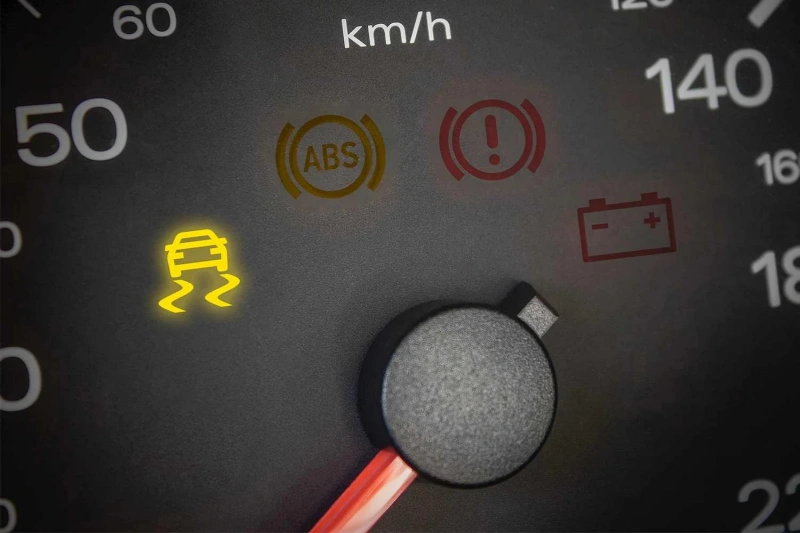
You may first notice that the ABS warning light, traction control warning light, and electronic stability control warning light on the instrument panel come on simultaneously or one after another.
ABS Warning Light
The ABS light coming on is the most obvious indication.
However, it’s important to note that you shouldn’t replace the wiring harness just because the warning light is on. A lit ABS warning light does not necessarily mean the ABS wiring harness is damaged. Issues such as a faulty wheel speed sensor, corroded connectors, open circuits or short circuits, low voltage, or poor grounding can all cause similar symptoms.
Traction Control Warning Light
The traction control warning light may also be related to a fault in the ABS wiring harness. The traction control system relies on wheel speed information to determine whether there are abnormal speed differences between the wheels.
If multiple systems report codes simultaneously, you should first read the fault codes from the ABS/ESC control module, then use real-time wheel speed data to determine which wheel and which circuit the problem is concentrated in.
Stability Control Warning Light
The stability control warning light may also be affected by abnormal wheel speed signals. If a signal from a wheel speed sensor cannot be transmitted, the system may be unable to assess the vehicle’s status, causing the ESC/ESP warning light to illuminate and limiting certain stability control functions.
Note: If the ABS, Traction Control, and ESC warning lights illuminate simultaneously, this does not necessarily mean that all three systems have experienced independent failures at the same time. Since they may share the same wheel speed signal, a fault in a single sensor, connector, or ABS wiring harness could trigger alerts in multiple related systems simultaneously.
Intermittent codes, dropouts, false activation, and erratic speed data
| Fault Symptom | English Term | Common Causes | How to Identify |
|---|---|---|---|
| Intermittent Fault | Intermittent Fault | Broken wires, loose terminals, or connector corrosion | Fault appears and disappears during bumps, steering movement, or suspension travel |
| Loss of Wheel Speed Signal | Wheel Speed Dropout | Damaged harness, faulty connector, or wheel speed sensor issue | Check live wheel speed data; one wheel suddenly drops to zero or shows unstable readings |
| ABS False Activation | False Activation | Incorrect wheel speed signal, sensor failure, or encoder ring problem | ABS activates during low-speed or light braking; verify live wheel speed data |
| Abnormal Wheel Speed Data | Erratic Speed Data | Harness damage, sensor fault, or encoder issue | One wheel speed reading is significantly different from the others |
| Intermittent Fault Codes | Intermittent / History Code | Loose electrical connection or temporary signal interruption | Fault codes appear and disappear; inspect harness routing and connectors carefully |
Note: These symptoms alone do not indicate damage to the ABS wiring harness; you need to make a comprehensive assessment based on a combination of trouble codes, real-time wheel speed data, and a wiring inspection.
Is It Safe to Drive With Suspected ABS Wiring Damage?
If you suspect that the ABS harness is damaged, you should consider whether it is safe to continue driving. This depends on whether the malfunction affects only the ABS function or has already compromised the basic braking system.
The ABS is designed to help prevent the wheels from locking up during emergency braking or when braking on low-traction surfaces. If it is merely an electrical malfunction of the ABS, some vehicles will still retain normal basic braking capability.
What normal braking may retain and which assistance features may be disabled
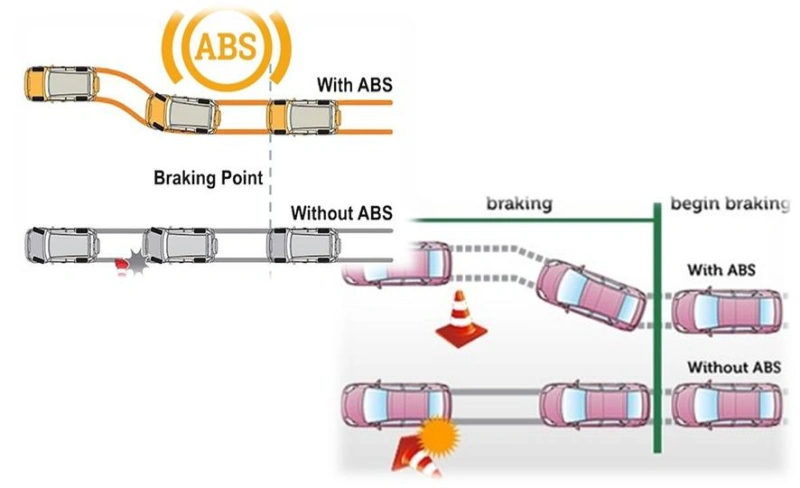
Normal braking may still work
If the ABS system merely detects a wiring harness or wheel speed signal fault, basic braking may still be available.
Manufacturer documentation for some vehicles explicitly states that when the ABS warning light remains on, the brakes may still function normally, but the ABS system is no longer available.
The fact that the brakes work does not mean the vehicle still has full braking safety capabilities.
ABS and electronic assistance may be disabled
When the ABS wiring harness prevents wheel speed signals from being transmitted properly, it may affect more than just the ABS. Because Traction Control and ESC/ESP rely on vehicle dynamic information—such as wheel speed—these assistance features may also be limited or disabled.
You may see the ABS, Traction Control, or ESC warning lights illuminate simultaneously. This does not necessarily mean that all three systems have failed individually; it may be that a single wheel speed signal failure is causing multiple systems to malfunction.
Conditions that warrant stopping and arranging professional inspection
You must not continue driving under the following circumstances:
- The red brake system warning light comes on;
- The brake pedal feels noticeably softer, harder, or requires significantly more force to press;
- There is a noticeable abnormality in the vehicle’s braking distance or braking feel;
- The vehicle pulls noticeably to one side when braking;
- There is a brake fluid leak or other obvious brake system malfunction;
- An ABS malfunction is accompanied by multiple brake system warning lights or vehicle malfunction indicators;
- You cannot confirm whether the basic brake system is functioning properly.
It is particularly important to note that some brake system malfunctions may affect the ABS and power brakes. Even if the vehicle is able to brake, you may need to apply more force to the brake pedal.
How Can You Tell a Bad Harness From a Bad Wheel-Speed Sensor?
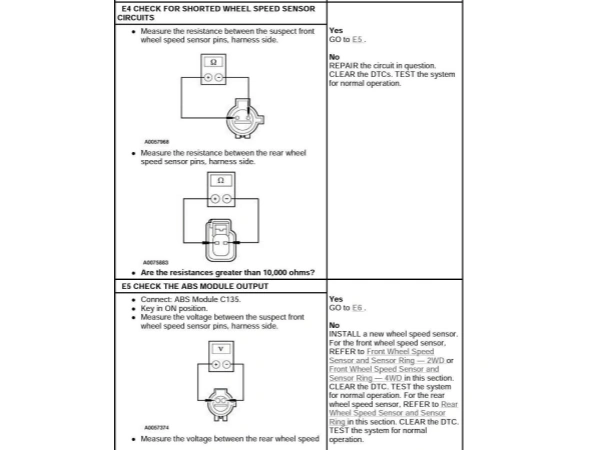
When a wheel speed signal fault occurs in the ABS system, the problem may lie with the ABS harness, connectors, mechanical components, or even the control module.
The correct method for diagnosis is to analyze the fault location, signal status, and circuit integrity.
Compare open circuits, shorts, connector faults, sensor failure, and signal faults
| Fault Type | Common Causes | Typical Symptoms | How to Identify |
|---|---|---|---|
| Open Circuit | Broken wires, loose terminals, or sensor circuit failure | ABS loses wheel speed signal; specific fault code may appear | Check wiring continuity and test the sensor separately |
| Short Circuit | Damaged insulation, ground short, or wire contact | Persistent fault and circuit-related warning codes | Check for shorts to ground or other circuits |
| Connector Fault | Loose plugs, corrosion, weak terminals, or water intrusion | Intermittent faults affected by vibration or moisture | Inspect connector lock, pins, and terminal condition |
| Sensor Failure | Damaged wheel speed sensor or abnormal output | Wiring works, but wheel speed signal is incorrect | Test sensor separately or replace for verification |
| Signal Fault | Poor connection, sensor issue, or encoder problem | Speed data drops, jumps, or differs from other wheels | Check ABS live data with a diagnostic scan tool |
Tip: It is important to note that even if the continuity test shows normal results, this does not necessarily mean that the ABS wiring harness is free of problems. Some wiring harness faults are intermittent; the circuit may function normally when the vehicle is stationary, but may open when the vehicle is turned, driven over bumps, or the suspension moves.
Why a tone ring, wheel bearing, tire mismatch, or module fault can mimic wiring damage
An ABS fault code doesn’t necessarily indicate a wiring harness issue; sometimes it could be caused by a mechanical component or a problem with the control system. The ABS module only checks whether the wheel speed signals are normal; it does not directly test the condition of the wiring harness.
| Possible Cause | Why It Looks Like a Harness Fault | How to Identify |
|---|---|---|
| Tone Ring Damage or Contamination | Missing teeth, cracks, rust, or debris can cause intermittent wheel speed signal loss | Inspect the tone ring and check if faults occur at specific speeds or positions |
| Wheel Bearing Play | Excessive bearing movement changes sensor-to-ring clearance and affects signal stability | Check for wheel looseness, abnormal play, or runout |
| Tire Mismatch | Different tire sizes create wheel speed differences that ABS may interpret as a fault | Verify all tires match the vehicle specifications |
| ABS Module Fault | Module processing errors can appear similar to wiring or signal problems | Consider module failure only after sensor and harness checks pass |
Which Diagnostic Data Should You Check First?
There may be an issue with the ABS wiring harness, so don’t rush to disconnect the harness or replace the wheel speed sensor. The correct approach is to use a diagnostic tool to review the data and determine whether the signal isn’t being generated, whether it’s being generated but not transmitted, or whether the module is unable to interpret the signal correctly.
ABS Troubleshooting Methods:
- ABS trouble codes—these indicate the general area where the fault lies;
- Freeze frame data—this shows the vehicle’s condition at the exact moment the fault occurred;
- Real-time wheel speed data—this helps you identify which wheel’s signal is abnormal.
ABS-specific DTCs, freeze-frame information, and live wheel-speed comparison
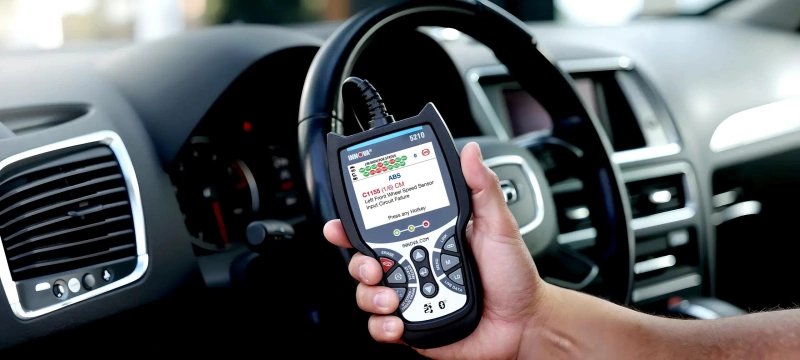
Start With ABS-Specific DTCs
The first step is to read the ABS-specific trouble codes—don’t just read the general trouble codes.
But keep one thing in mind: Just because a trouble code indicates a specific wheel speed sensor doesn’t mean the sensor is necessarily faulty.
There could be several underlying causes:
- A break in the right front ABS wiring harness;
- Poor contact at the connector terminals;
- The wheel speed sensor itself is faulty;
- There is an issue with the magnetic encoder ring or gear ring;
- Excessive play in the wheel hub bearing is causing unstable signals.
Check Freeze-Frame Data Before Clearing Codes
Freeze-Frame Data refers to the vehicle status information saved by the ABS module at the exact moment a fault occurs.
It may record:
- Vehicle speed at the time of the fault;
- Speeds of all four wheels;
- Braking status;
- System operating status.
Tip: Many people rush to clear the trouble codes as soon as they read them, and then test-drive the vehicle. Clearing the codes in this way erases critical information from the moment the fault occurred, leaving you without an important clue for future troubleshooting.
Compare Live Wheel-Speed Data
Real-time wheel speed data is a key indicator for diagnosing ABS wiring harness issues.
Under normal conditions, when the vehicle is traveling in a straight line, the speeds of all four wheels should be roughly the same. If the data for a particular wheel suddenly drops to zero, fluctuates erratically, or is noticeably faster or slower than the other wheels, there may be a problem with that wheel’s signal.
Intermittent clues linked to steering, suspension travel, moisture, and vibration
Intermittent faults in ABS wiring harnesses can be quite difficult to diagnose. The problem may only occur during actual driving.
| Trigger Condition | Possible Cause | Inspection Focus |
|---|---|---|
| Fault During Steering | Harness stretching, bending, or internal wire break | Inspect harness movement areas near the steering knuckle |
| Fault During Suspension Movement | Poor harness routing, abrasion, or excessive stress | Check clips, mounting points, and bending locations |
| Fault After Rain or Water Exposure | Connector water intrusion or terminal corrosion | Inspect connector sealing and terminal condition |
| Fault on Rough Roads | Loose connections or damaged internal conductors | Monitor signal changes while moving or flexing the harness |
For intermittent ABS malfunctions, you need to consider the following:
- Conditions under which the malfunction occurs;
- Real-time wheel speed data;
- Inspection of wiring harness movement;
- Inspection of connectors;
How Do You Inspect the ABS Harness?
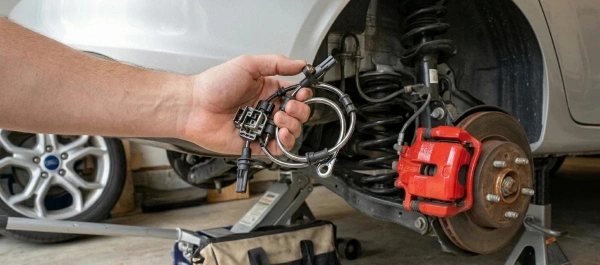
When inspecting the ABS harness, your goal is to determine whether the harness can consistently and reliably transmit wheel speed signals despite prolonged vehicle vibration, steering, suspension movement, and harsh environmental conditions.
The areas where the ABS harness is installed are susceptible to mechanical wear, tension, heat, moisture, and road contaminants. The inspection sequence is as follows: external condition → connectors → wire integrity.
Routing, chafing, stretching, heat damage, corrosion, water, and loose terminals
Check Harness Routing and Physical Damage
The first step is to inspect the routing of the ABS wiring harness.
Pay close attention to the following points:
- Is the wiring harness misaligned or has it shifted from its original mounting position?
- Is it too close to any rotating components?
- Does the suspension’s back-and-forth movement repeatedly pull on the wiring harness?
- Are any clips or brackets missing?
Note: Even if the harness’s mounting position has changed and there is no visible damage, prolonged pulling may cause the internal conductors to fatigue and break.
Look for Chafing, Stretching, and Heat Damage
Chafing is a common issue with ABS wiring harnesses and may be caused by continuous friction between the harness and metal brackets or body components.
Check the following:
• Whether the wiring harness shows obvious signs of stretching;
• Whether there is hardening or cracking at bent sections;
• Whether it is located near high-temperature areas such as the exhaust system or brake components.
It is important to note that an intact outer sheath does not necessarily mean the interior of the ABS wiring harness is in good condition. Some faults occur inside the harness—such as fatigue fractures in the copper conductors—which may not be visible from the outside.
Check Corrosion, Water Intrusion, and Loose Terminals
The ABS wiring harness connector is located near the wheels and is susceptible to exposure to rain, dirt, road salt, and other elements.
When inspecting, pay attention to the following:
- Check for water marks inside the connector;
- Check for discoloration or rust on the terminals;
- Check for damage to the O-ring;
- Check for loose terminals.
Connector pin fit, seals, clips, and previous repairs
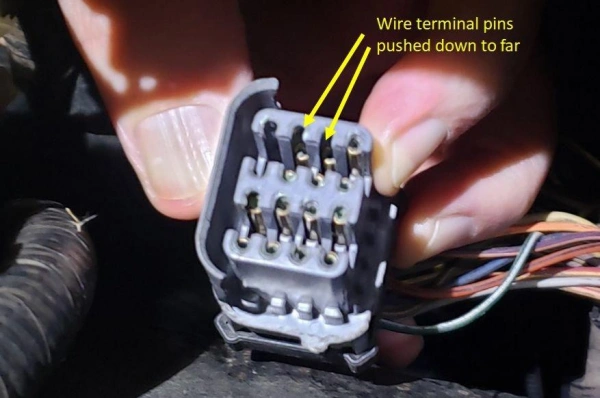
| Inspection Item | Key Checks | Common Issues | Impact |
|---|---|---|---|
| Terminal Fit Condition | Check bent terminals, pushed-out pins, contact tightness, and lock engagement | Poor terminal contact | Works when stationary but causes intermittent faults during vibration |
| Seals and Retaining Clips | Check missing or hardened seals, broken clips, connector looseness, and harness routing | Connector movement or incorrect positioning | Signal instability even when terminals are not damaged |
| Previous Repair History | Inspect areas that have been repaired before | Poor tape repairs, unsealed joints, low-quality crimps, or stretched repaired wires | Reduced mechanical strength, water resistance, and long-term reliability |
How Do You Test an ABS Wire Harness?
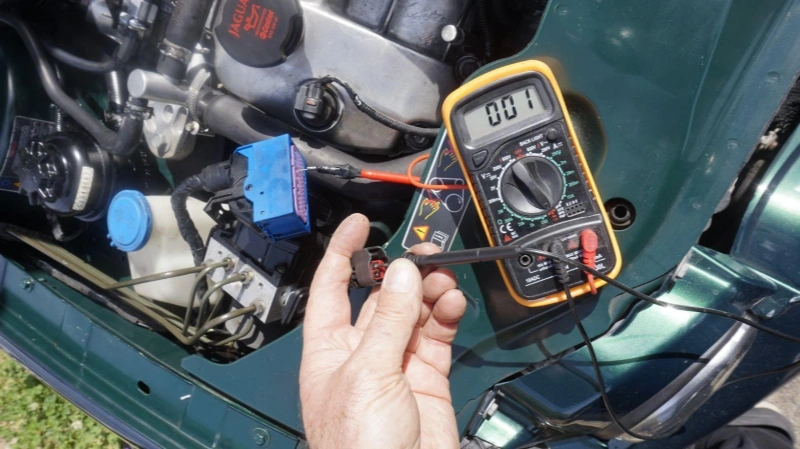
The purpose of testing the ABS wiring harness is to verify whether the wheel speed signal path can reliably transmit the signal.
The correct testing procedure is as follows:
First, consult the service manual → Disconnect the ABS control module and take appropriate protective measures → Test the continuity of the wiring → Simulate the vibration conditions encountered during actual driving → Perform a dynamic signal test if necessary.
Service-information checks before disconnecting modules
Before testing the ABS wiring harness, the first step isn’t to rush to unplug it.
You need to first figure out where the ABS control module is located, how the wheel speed sensor wires are routed, what each pin on every connector is for, whether the sensors are active or passive, and so on.
Continuity, short-to-ground, short-to-voltage, resistance, and wiggle tests
| Test Item | Purpose | Test Method | Notes |
|---|---|---|---|
| Continuity Test | Check circuit integrity and detect obvious open circuits | Disconnect both ends of the circuit and measure continuity between matching pins | Good continuity does not rule out intermittent faults |
| Short-to-Ground Test | Check if signal or power wires are shorted to vehicle ground | Disconnect connectors and measure for unwanted continuity between wire and chassis ground | Common causes include damaged insulation, abrasion, water intrusion, and contact with metal parts |
| Short-to-Power Test | Check if a wire is incorrectly connected to a power supply | Use the wiring diagram to locate test points and check abnormal voltage presence | Do not test pins randomly; always follow the circuit diagram |
| Resistance Test | Check wire resistance, connector resistance, and terminal contact condition | Measure resistance across the harness and terminals with a multimeter | ABS sensor resistance varies by vehicle; do not apply a fixed value to all models |
| Wiggle Test | Locate intermittent harness faults | Keep test equipment connected and gently move the harness while monitoring signals or data changes | Signal changes during movement may indicate conductor fatigue, poor terminal contact, or mounting issues |
Voltage-drop or oscilloscope testing when static checks pass
If the continuity and short-circuit checks are normal but the ABS fault persists, further dynamic testing is required.
Voltage-Drop Test
The Voltage-Drop Test is used to check for hidden resistance in a circuit while it is active.
Examples include oxidized or corroded terminals, loose crimp connections, or wires that are partially broken but not completely severed.
These issues cannot be detected at all by static testing with a multimeter, but they affect signal transmission as soon as the circuit is active.
Oscilloscope Testing
An oscilloscope is used to observe changes in the output waveform of the wheel speed sensor, making it easy to see what the signal looks like at a glance.
An oscilloscope can help you pinpoint the source of the problem:
- A problem with the sensor’s output;
- Signal loss during transmission through the wiring harness;
- Poor contact at the connector;
- Mechanical issues
Repair the Wiring or Replace the Harness?
Once a problem with the ABS wiring harness has been confirmed, the first step is to determine whether the damage can be repaired to a condition that approaches the original factory reliability. In addition to restoring electrical continuity, the repair must also ensure:
- Stable electrical connections;
- Water resistance and corrosion protection;
- Ability to withstand vehicle vibrations and suspension movement;
- No change to the original stress conditions of the wiring harness.
Decision factors for local damage, connector failure, contamination, and repeat faults
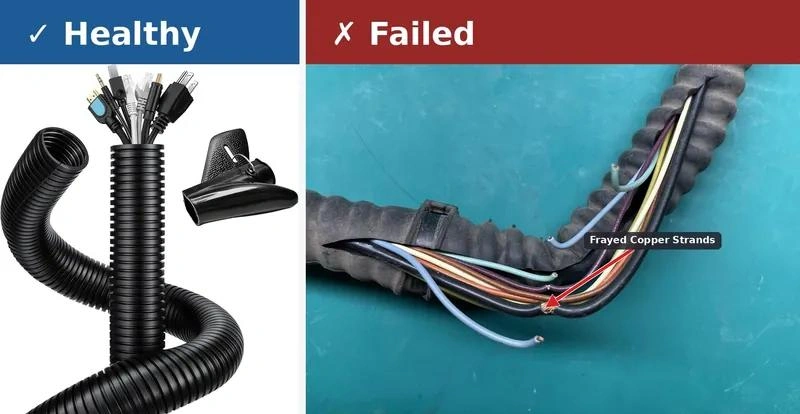
When Repair Is Usually Appropriate
If there is localized wear on the jacket, minor damage to the outer sheath of a single conductor, damage to a single terminal, or damage to the connector’s locking mechanism or seal.
In such cases, functionality can be restored by replacing the terminal, repairing the affected section of the conductor, or replacing the connector assembly.
When Replacement Is a Better Choice
| Replacement Condition | Details | Reason |
|---|---|---|
| Extensive Damage | Multiple areas show abrasion, burns, hardening, or severe cracks | Too many repair points reduce overall harness strength and reliability |
| Internal Corrosion | Moisture or corrosion has spread inside the copper conductor | Increased resistance cannot be restored by external repair |
| Repeated Failure at the Same Location | ABS faults return after previous harness repairs | Overall harness condition has degraded and reliability is reduced |
| Severely Damaged Connector | Connector housing deformation, failed seals, or burned/corroded terminals | Local repair cannot restore original connection reliability |
Consider the Damage Location
The location of the damage is very important.
If the damage occurs:
- In the middle of the wiring harness, where it is easier to secure → repair may be straightforward;
near a sensor - Connector → careful assessment is required;
- Near a connector, a sealed area, or an area subject to frequent movement → replacement is generally preferred.
Sealed splices, correct wire, strain relief, routing, and connector repair
| Repair Item | Key Requirements | Common Mistakes | Consequences |
|---|---|---|---|
| Use Sealed Crimp Connections | Use proper crimp connections and sealed heat shrink tubing to restore electrical connection and protection | Wrapping with electrical tape only | Quick failure due to water, dirt, temperature changes, and vibration near the wheel area |
| Use Correct Wire Specifications | Match wire size, insulation type, temperature rating, and flexibility requirements | Replacing with any available wire | Signal loss, mechanical fatigue, and reduced long-term reliability |
| Restore Strain Relief and Routing | Restore clips, wire slack, bend direction, and safe clearance from moving parts | Repair makes the harness too short and pulls the connector during steering | Works temporarily but may fail again over time |
| Repair or Replace Connectors Correctly | Verify terminal compatibility, seal installation, locking mechanism, and pin position | Replacing only the housing without checking terminals or seals | Unreliable connection and unstable signals |
How Do You Confirm the Repair?
After repairing the ABS wiring harness, do not assume the repair was successful just because the warning light has gone out. The ABS system is a dynamic control system; wiring harness issues may disappear when the vehicle is stationary but may reappear when the vehicle is in motion, turning, experiencing vibrations, or undergoing temperature changes.
Clear codes, verify live data, perform a safe road test, and recheck routing
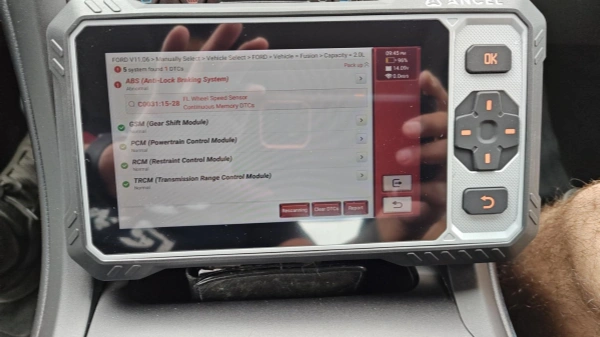
Clear Codes and Confirm the Fault Does Not Return
After repairs are complete, the first step is to use a diagnostic tool to clear the trouble codes from the ABS control module.
After clearing the codes, restart the vehicle and check the following:
- Whether the ABS warning light comes on again;
- Whether the Traction Control or ESC warning light appears;
- Whether the trouble codes are immediately recorded again.
Tip: The disappearance of fault codes does not necessarily mean the repair was successful.
Intermittent issues, such as internal wiring breaks or loose terminals, may appear normal while the vehicle is parked but can cause the codes to reappear after driving for a while. Therefore, clearing the codes is only the first step in verification.
Verify Live Wheel-Speed Data
The second step is to check the Live Data.
Pay close attention to:
- Whether the wheel speed readings for all four wheels are changing normally;
- Whether any wheel speed reading suddenly drops to zero;
- Whether there are any sudden changes or noticeable deviations in speed.
- During normal straight-line driving, the wheel speed data for each wheel should be essentially consistent.
If you’re repairing the right front ABS wiring harness, focus on the right front wheel speed signal. If the right front wheel speed suddenly drops while driving, it indicates that the problem hasn’t been resolved.
Perform a Safe Road Test
Step 4: Conduct a safety road test.
The road test is designed to simulate real-world operating conditions for the wiring harness: vibration, steering, suspension movement, and changes in speed.
During the test, pay attention to the following:
- Whether the ABS light comes on again;
- Whether the traction control or ESC triggers an alert;
- Whether there is any abnormal ABS engagement during braking;
- Whether the wheel speed data on the diagnostic tool remains stable.
Recheck Harness Routing After Repair
Step 3: Re-inspect the routing and installation of the wiring harness.
Key points to check:
- Are the clips snapped back into place?
- Is the wiring too close to the tires or moving suspension components?
- Is the wiring taut?
- Is the bend radius too small?
- Are the connectors under excessive tension?
Frequently Asked Questions
Q1: Can a damaged ABS wire cause the speedometer to fail?
Yes. The vehicle speed signal typically comes from the ABS wheel speed sensors. If the ABS wiring harness is damaged, causing a loss of the wheel speed signal, the speedometer may malfunction, reset to zero, or fluctuate.
Q2: Why does the ABS light appear only when turning?
When turning, the suspension rolls, the wiring harness is pulled, or the speed difference between the inner and outer wheels increases—all of which can expose previously loose connections or signal abnormalities. Common causes include: poor contact in the wheel speed sensor wiring harness, a faulty steering angle sensor, or abnormal signals from the outer wheel sensor.
Q3: Can connector corrosion create an intermittent ABS code?
Yes. Oxidation of connectors or loose terminals can lead to unstable contact resistance. When the vehicle vibrates or temperatures fluctuate, the signal may come and go, causing the fault code to appear and disappear intermittently. This type of intermittent fault is a typical symptom of an ABS wiring harness issue.
Q4: Will disconnecting the battery clear an ABS wiring fault?
It does not truly resolve the issue. Disconnecting the battery can reset the ECU and clear temporary fault codes, which may cause the warning light to go out temporarily; however, if the problem is caused by hardware issues such as a wiring harness break or a damaged sensor, the fault code will reappear after driving for a short distance. The correct approach is to clear the codes using a diagnostic tool and then verify the repair through a road test.
Conclusion: ABS Wire Harness Symptoms: Diagnosis and Repair Guide
The ABS wiring harness is the core transmission link of a vehicle’s safety control system; its electrical performance, mechanical stability, and long-term reliability directly affect the proper operation of the ABS, traction control, and vehicle stability control systems.
With this diagnostic and repair guide, you can more accurately distinguish between ABS wiring harness failures and issues with other related components, reduce unnecessary part replacements, and ensure that the vehicle’s brake assist system remains in a safe and stable operating condition.
Choosing Linkwings means not only selecting wiring harness connection products that have undergone rigorous quality control, but also choosing a reliable, long-term partner who can work with you to tackle complex application challenges. Feel free to contact us anytime!

Nicole
The founder of Linkwings Electronics.
10+ Years Experience | 1000+ Global Projects Completed
Specialized in:
- Custom Wire Harness Assembly
- Automotive & Industrial Cable Harness Manufacturing
- Precision Crimping & Terminal Processing
- OEM / ODM Wire Harness Solutions
Need help with your project?
Let Linkwingselec deliver your next wire harness solution.