Home » Types of Trailer Wiring Harnesses: A Practical Guide
Statistics on common faults in trailer electrical systems show that poor connections, signal loss, and short circuits caused by selecting the wrong wiring harness account for a high percentage of issues. This is because wiring harnesses of different specifications vary in terminal material, sealing rating, and wire gauge capacity.
The correct approach is to first identify your trailer’s features → then determine how many wires are needed → and finally select the corresponding plug type.
This guide covers every key step in selecting a trailer wiring harness—from connector types, circuit functions, and installation methods to materials, manufacturing processes, and testing and verification—to help you establish a comprehensive decision-making framework.
What Are the Main Types of Trailer Wiring Harnesses?
The wiring harness is responsible for transmitting commands from the tow vehicle to the trailer.
The most basic trailers only need to transmit lighting signals: whether the taillights are on, whether the brake lights are on, and whether the turn signals are flashing.
If your trailer is equipped with electric brakes, a reverse lock, or auxiliary power, you’ll need additional wiring. Each additional feature requires an extra wire. When selecting a connector, you should first confirm which features your trailer has and then match the connector type accordingly, rather than simply looking at the plug’s shape.
4-way flat harnesses for basic lighting
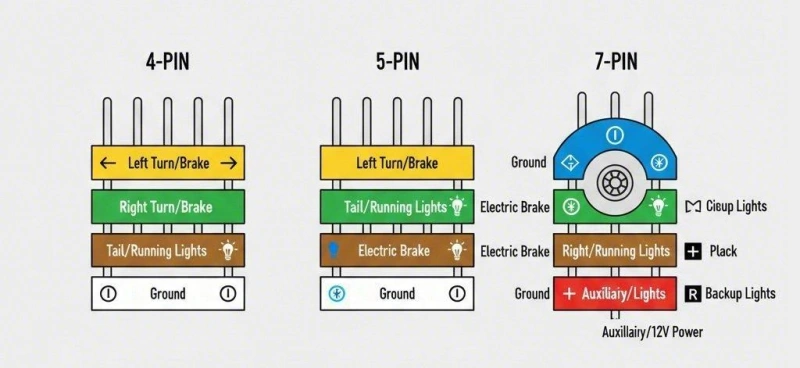
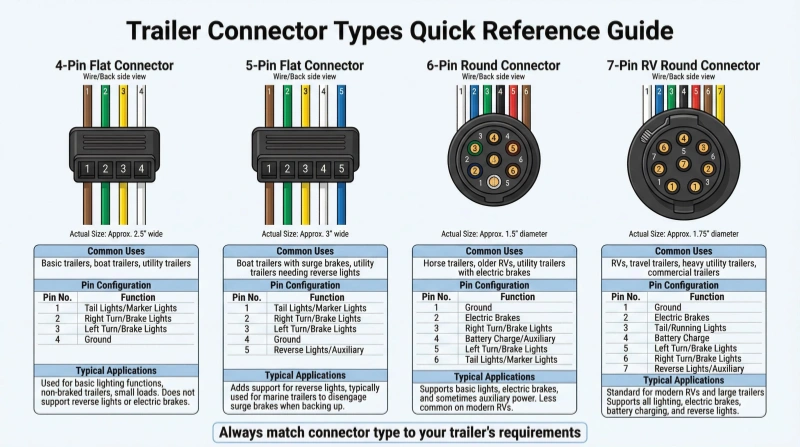
The 4-way flat harness is primarily used for small trailers that require basic lighting functions. It consists of four wires:
- Ground
- Tail/Running Lights
- Left Turn + Brake
- Right Turn + Brake
Why choose a 4-pin connector?
Because it transmits only the basic lighting signals required by regulations and does not include any additional control functions. It features a simple design, low cost, and easy installation, reducing unnecessary wiring connection points.
When Should You Avoid Using a 4-Pin Connector?
If your trailer has electronic brakes, reverse lights, or a hydraulic overrun brake with a reverse lock, a 4-pin connector may not be sufficient. Since a 4-pin connector lacks additional wires, it cannot transmit these control signals.
Common Mistakes
Some people simply buy a connector with the same number of pins as the socket.
This approach is incorrect. The correct method is:
What features does the trailer have? → How many signal lines are needed? → Select the corresponding connector
5-way connectors for surge-brake lockout
A 5-way connector is a 4-pin connector with one additional wire.
It includes:
- Ground
- Tail/Running Lights
- Left Turn/Brake
- Right Turn/Brake
- Additional Circuit
The fifth wire is used for the Surge Brake Lockout (hydraulic inertia brake reverse lockout).
What is a Surge Brake?
This system is suitable for boat trailers, small RV trailers, and light- to medium-duty trailers.
Why is a fifth wire needed?
When the vehicle reverses, the trailer pushes forward against the brake mechanism, causing the trailer brakes to engage and making it difficult for the vehicle to back up.
The fifth wire connects to the vehicle’s reverse light signal. When the vehicle is shifted into reverse, the reverse light outputs a 12V signal, which activates the fifth-wire locking solenoid valve, temporarily disabling the hydraulic brakes so the trailer can reverse normally.
When Should You Choose a 5-Pin Connector?
If your trailer has hydraulic overrun brakes, requires frequent reversing, or is used for boat towing, a 5-pin connector may be more suitable than a 4-pin one.
Tip: Do not assume that the fifth pin is always used for the reverse lock. Different manufacturers may assign different functions to it. Before installation, you must verify the pin definitions of the connector, the trailer wiring diagram, and the vehicle’s output signals.
6-way round connectors for added power or brakes
The 6-way round connector is used for medium-sized trailers that require additional functionality.
It provides expanded control capabilities, including:
- Basic lighting circuits
- Ground
- Electric brake
- 12V auxiliary power
When is a 6-pin connector appropriate?
Common Applications:
- Horse Trailers
- Some equipment transport trailers
- Vintage RV trailers
- Medium-sized utility trailers
When is a 6-pin connector not recommended?
If your trailer has only two taillights, no brakes, and no power requirements, using a 6-pin connector may be overkill and could increase:
- Wiring complexity
- Waterproofing requirements
- Troubleshooting difficulty
7-way blade and 7-way round systems for towing functions
7-way connectors are primarily used for trailers that require multiple control functions.
There are two types: 7-way blade (7-pin blade-style) and 7-way round (7-pin round).
Although both are called 7-pin connectors, their physical shapes and pin configurations may differ, so they cannot simply be considered interchangeable.
| Comparison | 7-Way Blade (RV-Style) | 7-Way Round |
|---|---|---|
| Also Called | RV-style 7-way | 7-way round |
| Connector Design | Flat blade-style terminals | Round-pin terminals |
| Supported Circuits | Tail/running lights, turn signals, ground, electric brakes, reverse signal, 12V auxiliary power, and other auxiliary circuits | Can support the same general towing functions, but the pinout may differ |
| Typical Applications | Travel trailers, large utility trailers, RVs, and trailers with electric brakes | Commercial trailers, heavy-duty equipment trailers, and specific industrial applications |
| Key Advantage | Widely used in the North American light-duty trailer market; parts are easy to source | Robust contact design and secure connection for demanding applications |
| Typical Environment | Road towing, recreational towing, and general trailer use | Construction sites, heavy-duty applications, and frequent connection/disconnection |
| Compatibility | ⚠️ Same pin count does not mean automatic compatibility. Always verify the connector type, pinout, and function of each terminal before using an adapter or rewiring. | |
Tip: Although the 7-way blade and 7-way round connectors both have seven pins, their physical structures are completely different, so they cannot be directly interchanged. When purchasing, you must verify both the type of socket on the tow vehicle and the type of plug on the trailer. Use a dedicated adapter when necessary, and do not attempt to modify them by force.
What Does Each Trailer Connector Circuit Do?
Each circuit in a trailer connector performs a specific electrical function between the vehicle and the trailer. The vehicle end provides signals or power, which the connector transmits to the trailer end; the trailer wiring harness then routes these signals to lights, brake actuators, or auxiliary equipment.
When performing actual repairs or selecting connectors, you should refer to the specific pinout of the connector and the manufacturer’s wiring diagram, rather than relying solely on the number of pins.
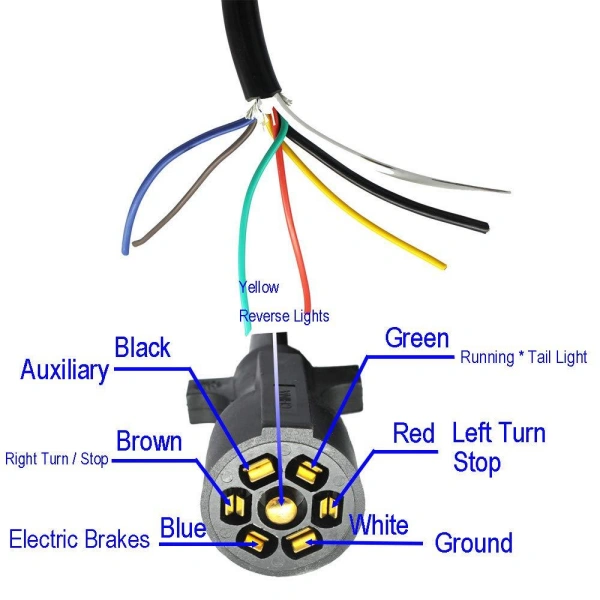
Ground, tail, turn, brake, reverse, auxiliary, and electric-brake circuits
Ground:
The ground connects the negative circuits of the trailer’s lights and other electrical loads back to the towing vehicle’s electrical system, allowing the current to complete a circuit.
When there is a grounding issue, you may notice multiple lights malfunctioning at the same time. This is because the current may be flowing back through paths it shouldn’t be taking.
Tail / Running:
The Tail/Running Lights control the trailer’s tail lights, side marker lights, and other lighting devices that need to operate in sync with the vehicle’s nighttime lighting.
This function is distinct from that of the brake lights and turn signals. The Tail/Running circuit provides a continuous light signal.
Turn:
The turn signal is used to transmit the vehicle’s left and right turn signals to the turn signals at the rear of the trailer, respectively.
Here’s a point that’s easy to get confused about: Just because a single wire carries both “turn” and “brake” signals doesn’t mean it has two separate circuits.
If only the left turn/brake signal is malfunctioning, while the right side and the taillights are working normally, you can check the Left Turn/Brake circuit section by section.
Brake:
“Brake Light” and “Electric Brake” are not part of the same circuit. “Brake Light” refers to the brake lights on the trailer that illuminate when the driver presses the brake pedal. “Electric Brake” refers to the trailer’s own electric brake system.
If you see the word “Brake,” you need to determine whether it refers to the brake lights or the trailer’s electric brake system.
Reverse:
The reverse circuit is used to transmit the signal to the trailer after the vehicle is shifted into reverse.
If the trailer is equipped with reverse lights, this circuit can be used to control them. On some trailers equipped with hydraulic overrun brakes, the reverse signal can also be used to control them.
Auxiliary:
The auxiliary power circuit is used to supply power to electrical equipment on the trailer; it is not a lighting or signal circuit.
Please note the following: The auxiliary power circuit is not intended for “direct connection to any device.” Specific considerations include the vehicle’s power supply capacity, fuse protection, wire gauge, connector ratings, and the requirements of the equipment on the trailer.
Electric-Brake:
The Electric Brake Circuit is used to transmit brake control signals to the trailer’s electric brakes.
It is different from the brake light circuit: while the brake lights signal to vehicles behind that “the vehicle is braking,” the Electric Brake Circuit is responsible for engaging the trailer’s own brakes.
Why wire colors alone should not be treated as proof
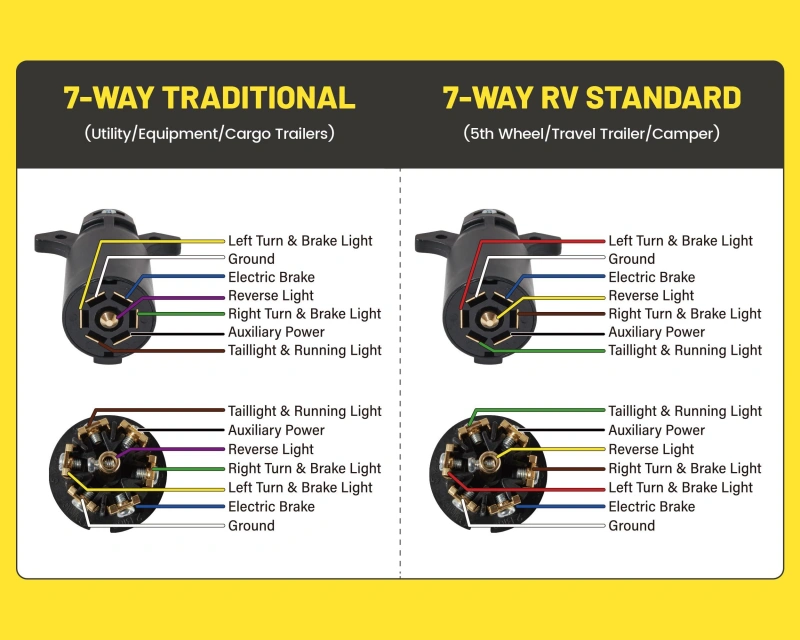
Wire colors can help you identify wires, but they should not be used as the sole basis for determining their function.
This is because, while there are common color conventions in the trailer industry, the correspondence between colors and functions may vary depending on the manufacturer, wiring harness, vehicle model, and subsequent repairs.
Vehicle-Side vs Trailer-Side Harnesses: What Is Different?
The vehicle-end component connects to the vehicle’s original lighting system, body control module, or factory-installed towing system, safely converting the vehicle’s signals into outputs that the trailer can use.
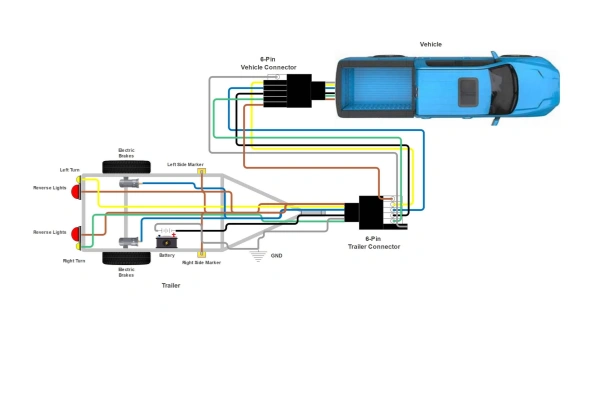
The trailer-end component receives these power and control signals from the connector and distributes them via the main wiring harness, branch circuits, and junction boxes to loads such as taillights, turn signals, electric brakes, and reverse lights.
When purchasing a trailer wiring harness, make sure you understand whether you are buying a vehicle-end solution or a trailer-end harness.
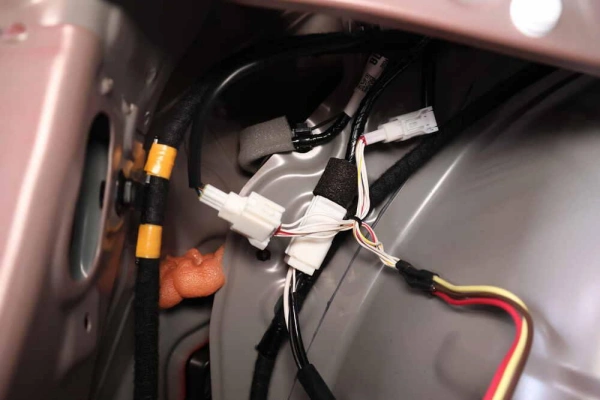
1. Tow-vehicle converter: Converts vehicle signals into signals compatible with the trailer
The tow-vehicle converter can receive three independent signals from the vehicle and recombine them into the two signals required by the trailer, enabling normal communication between the two sides.
2. T-Connectors: A Vehicle-Specific Solution That Does Not Cut the Original Wiring
A T-connector is a vehicle-specific plug-in wiring harness. The advantage of this method is that installation is relatively simple and does not require cutting the original wiring harness.
To determine whether to use a T-connector, first check your Year / Make / Model / Trim, then confirm whether a corresponding vehicle-specific harness is available. Do not assume that all T-connectors are compatible with all vehicles.
3. Factory Tow Package: Factory-installed towing kit
The Factory Tow Package indicates that the vehicle was equipped with the necessary electrical and mechanical systems for towing when it left the factory.
If your vehicle already has the Factory Tow Package, you do not need to install a universal 4-pin or 7-pin adapter. You should first check whether there is already a factory-installed towing socket, a pre-wired connector, or an OEM wiring connector at the rear of the vehicle.
Trailer main looms, branch circuits, junction boxes, and breakaway wiring
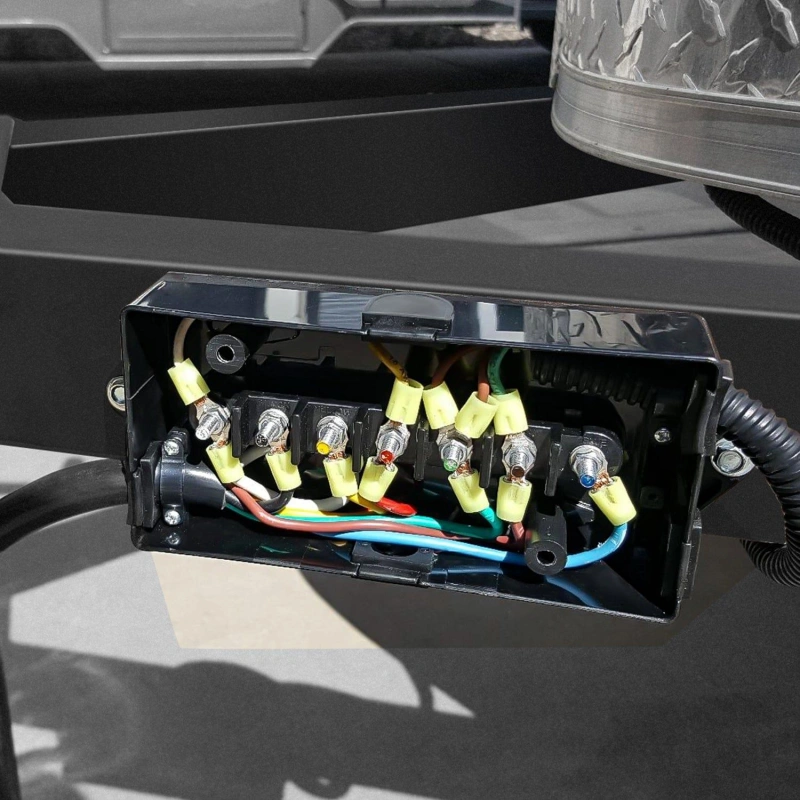
The vehicle unit is responsible for generating and outputting signals—converting commands such as lighting, braking, and steering into electrical signals that the trailer can recognize.
The trailer unit is responsible for distributing and executing signals—accurately routing the received signals to the corresponding lights, brakes, and auxiliary equipment.
1. Trailer Main Wiring Harness
The main wiring harness is the primary collection of wires extending from near the front connector of the trailer to the rear of the vehicle.
Design considerations for the trailer main wiring harness include:
Whether the wire gauge is suitable for the load and wire length;
- Whether the wires are securely fastened;
- Whether they are kept away from exhaust pipes, moving parts, and sharp edges;
- Whether they are adequately protected against water and wear;
- Whether branch points are appropriately located;
- Whether the ground circuit is reliable.
Tip: Trailers are frequently exposed to vibration, rain, mud, and road salt, so mechanical protection, corrosion prevention, and secure electrical connections are also critical.
2. Branch circuits
A branch circuit is a circuit that branches off from the main wiring harness and is dedicated to serving a specific group of loads.
When designing a trailer wiring harness, you should ensure that branch points:
- Are securely fastened;
- Are not left hanging and subject to tension;
- Use connection methods suitable for outdoor environments;
- Are not directly exposed to standing water.
3. Junction boxes
The junction box is installed at the front of the trailer and connects the wires from the trailer plug to the various branch circuits inside the trailer.
Without a junction box, you might have to search along the trailer frame for a hidden connection; with a junction box, you can simply open the cover to inspect each circuit.
Tip: A junction box is not a substitute for proper waterproofing. You still need to select the appropriate box, sealing method, and cable entry protection based on the installation location and environment.
4. Breakaway wiring
The breakaway system is primarily used for trailers equipped with electric brakes. You cannot rely on the vehicle as the sole power source.
This is because, in the event of an actual “trailer breakaway,” the trailer must have its own battery or an independent power source that meets the system’s design requirements.
Therefore, when designing a wiring harness for a trailer with electric brakes, you must consider: 7-way → Electric Brake. You must also consider:Breakaway Switch → Breakaway Battery → Electric Brake, as well as the battery’s charging and auxiliary power supply paths.
Plug-and-Play, Universal, or Custom: Which Design Fits?
When selecting a product, you shouldn’t base your decision solely on the purchase price. You should also consider fitment, installation, repairability, production volume, and cost.
Fitment, installation, repairability, production volume, and cost
| Criteria | Plug-and-Play / Vehicle-Specific | Universal Harness | Custom / OEM Harness |
|---|---|---|---|
| Fitment | Specific Year / Make / Model / Trim | Broad coverage; requires vehicle adaptation | Designed for a specific platform or project |
| Installation | OEM-compatible connectors; minimal splicing | Requires wiring, crimping, grounding, and testing | Designed for the project and assembly process |
| Workload | Low | Medium–High | Optimizable for mass production |
| Error Risk | Relatively low | Relatively high | Low after proper validation |
| Repairability | Easy to inspect at connectors and modules | Flexible; wires can be repaired or replaced | Repair points can be designed into the harness |
| Vehicle Coverage | Limited by available vehicle-specific SKUs | Broad | Usually one or a few platforms |
| Small Batches | Suitable for mature applications | Very suitable | Depends on development cost |
| Large Volumes | Suitable for mature models | Suitable, but less optimized | Very suitable |
| Development Cost | Medium | Low | High |
| Unit Cost | Depends on volume and design | Flexible for small batches | Can decrease with high-volume production |
| Best For | Specific vehicles, repair shops, retail, fast installation | Multi-vehicle coverage and small batches | OEMs, Tier suppliers, stable platforms, high-volume orders |
| Key Advantage | Precise fitment + fast installation | Broad coverage + flexibility | Customization + production optimization |
| Main Limitation | More SKUs and limited coverage | Higher installation and testing effort | Higher upfront development cost |
How Do Connector Formats Compare?
The choice of connectors for a trailer wiring harness depends on the number of circuits, the interface types at both the vehicle and trailer ends, local standards, the mechanical installation orientation, and the actual load requirements.
Circuit capacity, orientation, regional use, durability, and availability
| Comparison Factor | What to Check | Why It Matters | Common Mistake |
|---|---|---|---|
| Circuit Capacity | Required circuits: lighting, electric brakes, reverse, auxiliary power, etc. | Pin count alone does not define circuit functions. | Assuming 7-way means simply 4-way plus 3 wires. |
| Connector Format | Check Flat, Blade, Round, and mechanical fit. | Different shapes and contact layouts may not mate. | Assuming the same pin count means direct fit. |
| Pinout | Verify the function of each pin. | Different pinouts can cause circuit errors. | Relying only on wire color or pin count. |
| Regional Use | Check the connector system used in the target market. | Pinouts and connector systems vary by region. | Applying one market's wiring scheme to another. |
| Durability | Check terminals, sealing, locking, strain relief, and mounting. | Connectors face water, dirt, salt, vibration, and pulling forces. | Judging durability only by housing thickness. |
| Availability | Check local availability of connectors, terminals, and repair parts. | Supports easier repair and long-term supply. | Choosing uncommon connectors that are hard to replace. |
When an adapter works and when rewiring is safer
Using an Adapter:
To determine whether an adapter will work, we recommend checking three things:
- Does it plug in? — Does it physically fit and lock into place, without coming loose while driving?
- Do the signals match up correctly?—Ensure that each input is accurately routed to the correct output; don’t send the brake signal to the reverse lights.
- Can it handle the load?—In terms of current and voltage, can the adapter, terminals, and wiring harness withstand the actual load? This is especially critical for high-current circuits like electric brakes and auxiliary power supplies; don’t assume everything is fine just because the connectors look similar.
Rewiring:
- The trailer requires a dedicated circuit that the original connector simply does not provide, and an adapter cannot create one.
- The original wiring harness has aged, corroded, or been previously modified, leaving the underlying wiring in poor condition.
- The pinouts on both ends simply do not match, and an adapter cannot resolve this.
- Modifications are required for electric brakes or auxiliary power circuits.
- The mechanical or electrical connections of the original connector itself are no longer reliable.
How Do You Select the Right Trailer Harness?
When selecting a trailer wiring harness, we recommend that you start by considering the functions the trailer needs to perform, the signals the vehicle can provide, the actual load, the required length of the wiring harness, and the severity of the operating environment.
Match trailer functions, brakes, loads, length, environment, and tow vehicle
Step 1: Verify Trailer Functionality.
First, list all electrical functions that must work on the trailer, including taillights/tail lamps, left turn signal, right turn signal, brake lights, reverse lights, electric brakes, auxiliary power, etc. Determine the wiring harness circuits based on actual functionality, not on the number of wires.
Step 2: Verify the presence of a brake circuit.
If the trailer uses electric brakes, you need to confirm that the tow vehicle is equipped with the corresponding brake control system and that the wiring harness provides a separate brake circuit. You cannot simply upgrade a standard lighting harness to a “brake-equipped harness.”
Step 3: Verify the load.
The load refers to the actual current the wiring harness must carry. You need to know how much current the lights, brakes, and auxiliary equipment each require, and then check whether the wires, terminals, connectors, and protective devices can meet these requirements.
Step 4: Determine the wiring harness length.
You need to ensure there is sufficient installation clearance from the vehicle end to the trailer end to minimize excess cable forming large loops under the vehicle, sagging, or coming into contact with tires and the exhaust system.
Step 5: Assess the operating environment.
If the trailer is primarily used on regular roads, the focus should be on standard mechanical protection and connection reliability; if it is a boat trailer, greater attention must be paid to environments involving water, mud, salt, and corrosion.
Step 6: Check the tow vehicle itself.
You need to verify the vehicle’s year, make, model, and trim level, as well as whether it comes standard with a tow package. The method for controlling the taillights may vary by vehicle, so you cannot assume that all vehicles allow for a direct parallel connection to the taillight wiring.
Selection matrix for utility, boat, RV, equipment, and commercial trailers
| Trailer Type | Typical Electrical Needs | Key Harness Considerations | What to Avoid |
|---|---|---|---|
| Utility Trailer | Basic tail, turn, and brake lights; other circuits may vary. | Focus on basic lighting, grounding, and mechanical protection. | Choosing a complex connector without confirming vehicle compatibility. |
| Boat Trailer | Basic lighting; additional circuits may vary. | Prioritize water resistance, corrosion protection, sealing, and secure routing. | Using unsuitable connectors and ignoring moisture protection. |
| RV / Camper Trailer | Lighting, electric brakes, reverse, auxiliary power, and other circuits. | Identify all required circuits before selecting the connector and harness. | Assuming all RVs use the same 7-way pinout. |
| Equipment Trailer | Lighting; may include electric brakes and auxiliary circuits. | Match wire capacity and protection to actual loads; strengthen mechanical protection. | Using a basic lighting harness for high-load equipment. |
| Commercial Trailer | Lighting, braking, ABS-related systems, and auxiliary circuits. | Verify OEM interfaces, standards, loads, and system requirements. | Applying a light-duty trailer harness to heavy-duty systems. |
Which Materials and Construction Features Matter?
The reliability of a trailer wiring harness depends on the conductors, insulation, connector design, and the harness’s external protection. When selecting a wiring harness, you should consider whether the conductors can reliably carry current, whether the insulation can withstand temperature and environmental conditions, whether the connectors can maintain a tight seal over the long term, and whether the harness is resistant to damage from vibration, friction, and tension.
Copper conductors, insulation, overmolding, sealing, abrasion protection, and strain relief
| Check Item | What to Confirm | Especially Important When | Common Mistake |
|---|---|---|---|
| Conductor | Copper type, conductor size, strand count, and construction | Long runs, high loads, and constant vibration | Checking only the cable diameter |
| Tinned Copper | Whether tinned copper is used | Wet, salty, and boat trailer environments | Assuming tinned copper is required for every application |
| Insulation | Type such as PVC, TXL, GXL, or SXL and its temperature/environment rating | High or low temperatures, oil exposure, and frequent flexing | Assuming thicker insulation is always better |
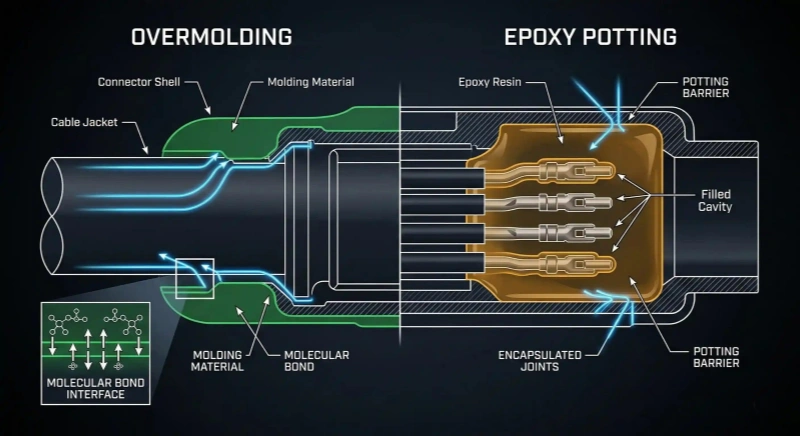
| Overmolding | Coverage of key connection areas and mechanical protection | Connector exits, branches, and outdoor applications | Assuming "overmolded" automatically means waterproof |
| Sealing | Connector seals, terminal seals, and cable-entry sealing | Rain, mud, and saltwater exposure | Checking only the plug, not intermediate connections |
| Abrasion Protection | Cable jacket and external abrasion protection | Chassis, frame, and tire areas | Using tape instead of proper mechanical protection |
| Strain Relief | Reliable strain relief at the connector exit | Frequent plugging, vibration, or cable tension | Allowing cable weight to pull on the terminals |
| Routing | Keep wiring away from heat, moving parts, and sharp edges | Almost all chassis-mounted installations | Focusing only on the cable, not its routing path |
How Should a New Harness Be Tested?
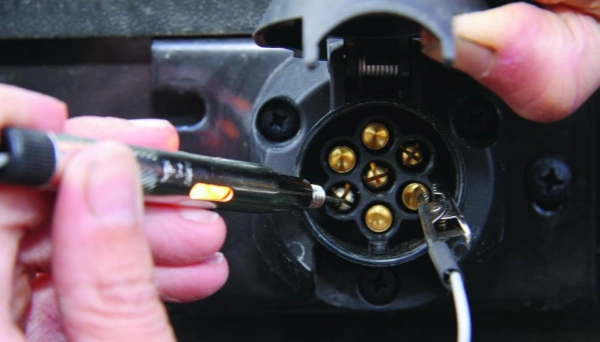
After installing a new trailer wiring harness, it is recommended to test it step by step in the following order: “Pin Assignment → Continuity → Voltage → Load Function → Braking → On-Road Test.”
Pinout verification, continuity, voltage-drop, lighting, brake, and road checks
| Test Stage | Test Method | Main Purpose | Proceed When Passed |
|---|---|---|---|
| 1. Pinout Verification | Check each pin against the wiring diagram | Prevent incorrect circuit assignment | Continuity test |
| 2. Continuity | Use a multimeter with power off | Confirm there are no open circuits | Short/isolation check |
| 3. Short / Isolation Check | Check for unwanted continuity between circuits | Identify shorts or incorrect connections | Voltage test |
| 4. Voltage Test | Measure voltage at the vehicle and harness output | Confirm correct power and signal transfer | Voltage-drop test |
| 5. Voltage-Drop Test | Measure voltage loss under actual load | Find high-resistance connections, wires, or grounds | Lighting test |
| 6. Lighting Test | Test tail, turn, brake, and other lights | Verify actual lighting functions | Brake test |
| 7. Brake Test | Check electric brakes per vehicle/controller requirements | Confirm the brake control circuit works correctly | Road check |
| 8. Road Check | Perform a safe real-world driving check | Verify reliability under vibration, turning, and movement | Final inspection |
Frequently Asked Questions
Q1: What is the difference between a 7-way blade and 7-way round plug?
Both are 7-pin connectors; the blade connector has flat, blade-shaped pins, while the round plug has round pins. They are not directly interchangeable.
In addition to their different shapes, the pin functions may also differ. Even if an adapter resolves the physical interface issue, you must still verify one by one whether the functions of each pin match.
Q2: Can a 4-way trailer use a 7-way tow-vehicle socket?
They cannot be plugged in directly; a dedicated adapter is required. After adapting, the lights will function normally, but additional circuits such as electric brakes and auxiliary power will have no signal source and therefore cannot be used.
Q3: What is a wishbone trailer wiring harness?
A wishbone wiring harness is a variation of a standard 4-way wiring harness. In a standard 4-way harness, a single brown wire powers the taillights, whereas a wishbone harness splits the taillight circuit into two separate wires—one for the left and one for the right—to power the taillights on each side of the trailer.
Q4: Do all trailers use the same wire colors?
No. Wire color definitions vary significantly across different standards and manufacturers. Never connect wires based solely on color; instead, consult the pinout diagram for the corresponding connector and connect the wires according to their respective functions.
Conclusion: Types of Trailer Wiring Harnesses: A Practical Guide
Selecting a trailer wiring harness involves multiple factors, including connector types, pin assignments, electrical loads, and system compatibility. From 4-way to 7-way, and from passive to active conversion, each solution has its own applicable scenarios and limitations.
As a professional trailer wiring harnesses supplier , Linkwings provides precisely tailored custom harness solutions based on different vehicle models and trailer configurations, ensuring accurate signal transmission for every channel and that every circuit meets load requirements.
Whether it’s a basic lighting trailer or a complex system equipped with electric brakes and auxiliary power, Linkwings can provide you with a simple and reliable wiring harness solution. We support customization of wire gauges, color coding, and connector types, and offer a comprehensive testing process to help you build a safe and stable trailer electrical system.

Nicole
The founder of Linkwings Electronics.
10+ Years Experience | 1000+ Global Projects Completed
Specialized in:
- Custom Wire Harness Assembly
- Automotive & Industrial Cable Harness Manufacturing
- Precision Crimping & Terminal Processing
- OEM / ODM Wire Harness Solutions
Need help with your project?
Let Linkwingselec deliver your next wire harness solution.