4 Pin vs 7 Pin Trailer Harness: Which Connector Do You Need?
Home » 4 Pin vs 7 Pin Trailer Harness: Which Connector Do You Need?
There are two common types of trailer wiring harnesses on the market: 4-pin and 7-pin. What exactly is the difference between them? You might be confused when choosing one.
The 4-pin wiring harness provides four basic functions: ground, taillight, left turn signal/brake light, and right turn signal/brake light. It is suitable for light-duty trailers. The 7-pin harness also includes features such as electric brake control, a 12V auxiliary power supply, and reverse lights, meeting the braking requirements of medium- and large-sized trailer RVs.
This article outlines the key differences between 4-pin and 7-pin trailer harnesses in terms of functional definitions, applicable scenarios, connector standards, and adapter solutions, helping you make the right choice based on your actual towing needs.
What is the main difference between a 4-pin and 7-pin harness?
The main differences between 4-pin and 7-pin trailer wiring harnesses are the number of functions and the types of trailers they are designed for. The 4-pin harness is used for basic lighting, while the 7-pin harness adds functions such as brakes, reverse lights, and auxiliary power to the basic lighting.
| Comparison Item | 4-Pin Trailer Wiring Harness (4-Way) | 7-Pin Trailer Wiring Harness (7-Way) |
|---|---|---|
| Number of Pins | 4 pins | 7 pins |
| Basic Functions | Left turn, right turn, tail lights, ground | Left turn, right turn, tail lights, ground, brakes, auxiliary power, reverse lights, etc. |
| Turn Signals | ✓ | ✓ |
| Tail / Marker Lights | ✓ | ✓ |
| Ground | ✓ | ✓ |
| Electric Brakes | ✗ | ✓ |
| Reverse Lights | ✗ | ✓ |
| Auxiliary Power | Usually not available | ✓ Usually supported |
| Trailer Battery Charging | ✗ | ✓ Can be supported through the auxiliary power circuit |
| Suitable Trailers | Small trailers, light-duty cargo trailers, and basic trailers | RV trailers, heavy-duty trailers, and trailers with electric brakes |
| System Complexity | Simple | More complex |
| Installation Difficulty | Lower | Higher |
| Cost | Lower | Higher |
| Typical Applications | Basic lighting requirements | Combined lighting, braking, reverse, auxiliary power, and other electrical requirements |
Note: “4-Way” and “7-Way” are general terms for common connector configurations and do not imply that all 4-pin or 7-pin connectors worldwide use exactly the same pinout. Markets such as North America, Europe, and Australia may use different standards.
4-pin vs 7-pin function comparison
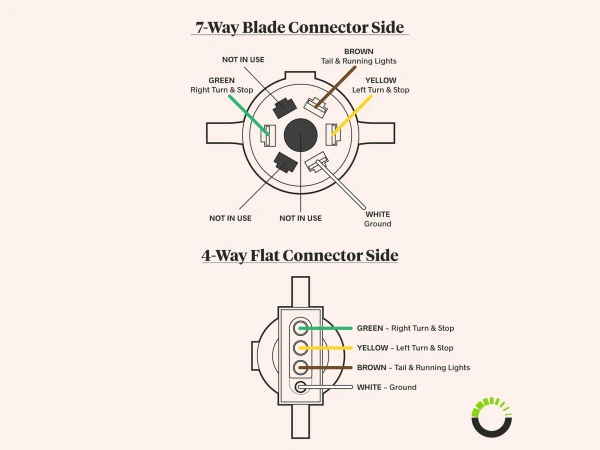
Basic Lighting Functions:
The functions of the first four pins on both the 4-pin and 7-pin harnesses are nearly identical, as both adhere to the basic lighting protocol defined by the SAE J1239 standard. Pin 1 serves as the system ground loop; pin 2 controls the taillights and clearance lights; pins 3 and 4 correspond to the left and right turn signals, respectively, which also function as brake lights.
Electric Brake Control:
Pin 5 is the key distinction between the 7-pin and 4-pin harnesses. It connects to the electric brake controller on the trailer, using a pulse-width modulation (PWM) signal to control the timing and intensity of the trailer’s braking force.
When the towing vehicle applies the brakes, the brake controller sends a synchronization signal to the trailer’s electromagnetic brake via pin 5, enabling coordinated braking between the trailer and the towing vehicle. The 4-pin harness lacks this channel and cannot support medium- to heavy-duty trailers equipped with electric brakes.
12V Auxiliary Power Supply:
Pin 6 provides a continuous 12V DC power output, with a typical rated current of 20A to 40A. It can directly power low-voltage equipment inside the trailer, such as lighting, water pumps, and ventilation systems. The 4-pin harness also lacks this capability, meaning the trailer must rely on its own battery reserve, posing a risk of running out of power during long-distance travel.
Reversing Light Linkage:
Pin 7 is responsible for transmitting the reversing light signal. When the towing vehicle shifts into reverse, this pin powers the trailer’s reversing lights to provide a visual signal to vehicles behind. This function is also absent in the 4-pin harness. This may impair the judgment of rear-view observers and result in traffic violations.
When is a 4-pin trailer harness enough?
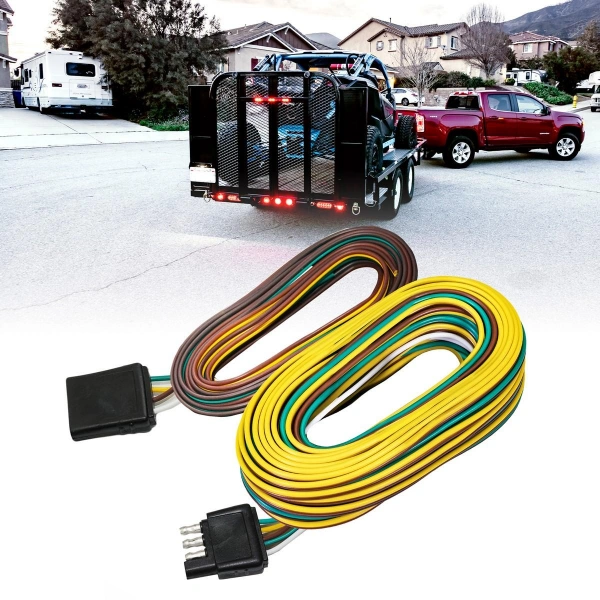
Whether a 4-pin wiring harness is “sufficient” depends on whether the trailer requires an independent braking system. When the trailer itself is not equipped with a braking system, the four basic functions provided by the 4-pin wiring harness meet the regulatory requirements for trailer lighting and signaling.
Applicable Scenarios
- Light-duty boat trailers: The combined weight of the boat and the trailer is generally below the threshold set by braking regulations. Trailer lights need to provide basic contour lighting and turn/brake signal transmission, which the functional channels of a 4-pin wiring harness can accommodate.
- Motorcycle/ATV trailers: The load capacity of a single motorcycle or all-terrain vehicle is limited. These trailers have a simple structure with no onboard electrical system and therefore no power supply requirements.
- Small utility and cargo trailers: Lightweight flatbed trailers used to transport building materials, gardening equipment, or camping gear are designed as lightweight, non-braked solutions by default; a 4-pin wiring harness is their standard electrical configuration.
Three Prerequisites for a 4-Pin Wiring Harness to Be “Sufficient”
- The trailer’s GVWR is below the braking threshold specified by local regulations: If the limit is exceeded, regulations mandate that the trailer be equipped with independent brakes, and a 4-pin wiring harness will not meet compliance requirements.
- No independent electrical loads on the trailer: There are no devices on the trailer that require an external power supply. If the trailer has its own battery and does not need to be charged while in motion, the lack of power from the 4-pin wiring harness is not an issue.
- The usage scenario does not involve frequent reversing: A 4-pin wiring harness does not support reverse light activation. If the trailer combination primarily travels in a straight line on open roads with minimal need for reversing, the impact of this missing feature is manageable; however, frequent reversing in tight spaces without a reverse light signal poses a safety hazard.
When do you need a 7-pin trailer harness?
When a trailer requires braking, power, or reverse signal linkage, a 4-pin wiring harness is no longer sufficient. A 7-pin trailer wiring harness is required.
1. The trailer is equipped with an electronically controlled braking system
This is one scenario where a 7-pin wiring harness is required. If the trailer is equipped with an electronically controlled braking system, the vehicle must transmit braking signals to the trailer’s braking system via a dedicated circuit—a capability that a 4-pin wiring harness lacks.
For heavier cargo trailers, RVs, or other trailers equipped with electronic brakes, a 7-pin wiring harness may be more suitable.
2. The trailer requires reverse lights or reverse signals
If the trailer is equipped with reverse lights, or if its control system requires the towing vehicle to provide a reverse signal, additional circuits are needed for connection. The 7-pin connector includes dedicated wires to transmit the towing vehicle’s reverse signal to the trailer.
3. The trailer requires a continuous auxiliary power supply
Some trailers not only require lighting but also need a 12V auxiliary power supply from the towing vehicle to power the trailer’s battery, interior lighting, control devices, or other low-power electrical equipment.
This goes beyond the basic lighting capabilities of a 4-pin wiring harness. A 7-pin wiring harness provides a dedicated auxiliary power line to meet the trailer’s expanded power needs.
4. The Trailer Is a Motorhome or Camping Trailer
Motorhomes and camping trailers incorporate more electrical equipment, such as batteries, interior lighting, controllers, and other auxiliary devices. These types of trailers require brake control and reverse signals.
If the trailer has multiple electrical functions and requires multi-channel signal exchange with the tow vehicle, a 7-pin wiring harness may be more suitable than a 4-pin wiring harness.
5. Trailers with Higher Weight and More Complex Functions
As trailer size and gross weight increase, so do their requirements for braking, safety signals, and auxiliary power. When selecting a wiring harness, it is also necessary to consider brake control, circuit capacity, grounding reliability, and the mechanical and environmental durability of the connectors.
For applications such as large freight trailers and heavy-duty equipment trailers, a 7-pin system offers better expandability.
6. Potential Future Additions of Electrical Features
If a trailer currently requires only basic lighting but plans to add electronic brakes, reverse lights, auxiliary power, or other electrical equipment in the future, a 7-pin system should be considered during the design phase.
Do trailer weight and brake laws affect the choice?
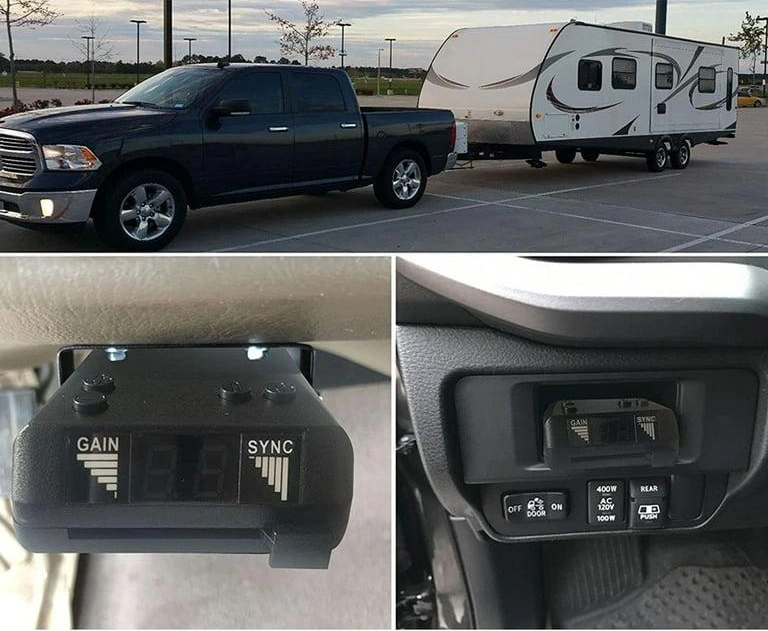
It does have an impact. The heavier the trailer, the higher the demands on the braking system and electrical connections. If regulations require the trailer to be equipped with an independent braking system, the wiring harness cannot be limited to just the taillights and turn signals; it must also account for the brake signal, power supply, and ground circuits.
1. The heavier the trailer, the higher the requirements for the brake wiring
As trailer weight increases, braking distance, braking stability, and emergency braking capability become critical issues. Many vehicle manufacturers explicitly require the use of a 7-pin connector with a dedicated brake circuit for heavier trailers.
However, trailer weight alone does not determine the need for a 7-pin connector; it may simply indicate that you require a more comprehensive braking system, which in turn dictates changes in wiring harness selection.
2. Electronic Brake Systems Require a Dedicated Brake Circuit
If the trailer is equipped with an electronic braking system, the brakes require a dedicated brake control signal from the tow vehicle.
The 7-pin trailer connector includes a dedicated “Trailer Brake Output” line specifically designed to transmit signals from the vehicle’s brake controller to the trailer’s brakes. If the trailer is equipped with an electronic braking system, a 7-pin system with a dedicated brake line is essentially required.
3. Local Regulations Are More Important Than the "Number of Pins"
Requirements for trailer braking systems vary significantly across different countries and regions, taking into account the trailer’s weight, maximum allowable gross weight, trailer type, and braking method.
The correct approach is as follows:
Trailer weight → Whether a braking system is required → What type of braking system is required → What electrical functions are needed → Select the corresponding connector and wiring harness
4. The Wiring Harness Itself Must Also Be Suited to the Load
Selecting a 7-pin connector does not automatically guarantee the wiring harness’s safety. For trailers equipped with electronically controlled brakes or auxiliary power, factors such as wire gauge, rated current, grounding method, fuse protection, and wiring harness length must all be taken into account.
Can you adapt 4-pin to 7-pin or 7-pin to 4-pin?
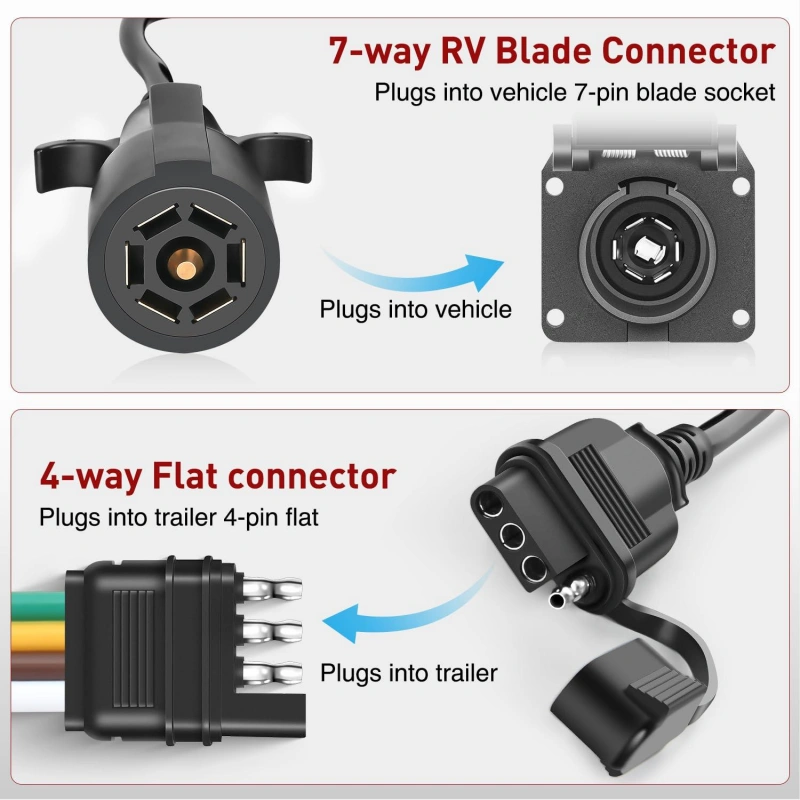
A 4-pin and a 7-pin trailer connector can be connected to each other using a dedicated adapter. However, when connecting a 4-pin vehicle to a 7-pin trailer, if the trailer requires electronic brakes, reverse lights, or auxiliary power, and the vehicle lacks the corresponding wiring, the adapter alone cannot provide these functions. Therefore, when selecting an adapter solution, you must ensure compatibility based on the connector types, the trailer’s features, and the vehicle’s actual wiring configuration.
Using a 7-to-4 adapter
When a 7-pin vehicle tows a 4-pin trailer, the 7-pin connector already includes all four circuits required by the 4-pin system. The adapter routes the corresponding four pins from the 7-pin connector to the 4-pin flat plug; the remaining three pins serve no purpose.
These adapters are widely available on the market, cost a few dozen yuan, and are plug-and-play—requiring no wiring or modifications.
Tip: In the 7-pin standard, some European-standard configurations use separate pins for turn signals and brake lights, while the 4-pin system combines them into a single circuit. If the vehicle and trailer belong to different standard systems, you must use an adapter with a signal-combining function; otherwise, conflicts may arise between the brake light and turn signal signals.
Upgrading from 4-pin to a functional 7-pin
The 4-pin wiring harness does not contain physical circuits for brake control, auxiliary power, or reverse lights; the adapter cannot create these circuits.
To achieve a fully functional 7-pin connector, the following additional work is required:
- Electric brake circuit: Install a brake controller on the tow vehicle, run a brake signal wire from the controller, and route it separately to pin 5 of the 7-pin connector.
- Auxiliary power circuit: Run a 12V power wire from the vehicle’s battery or alternator; after installing an in-line fuse, connect it to pin 6. The wire gauge should be no smaller than 10 AWG to handle continuous current.
Reverse Light Circuit: Tap a signal from the vehicle’s reverse light circuit and route it to pin 7. - Additionally, for newer vehicle models that use CAN bus control for lighting, a load resistor may need to be installed when converting from a 4-pin to a 7-pin connector to simulate the electrical load of the trailer lights; otherwise, the vehicle may falsely report a “bulb failure.”
Vehicle compatibility and brake controller requirements
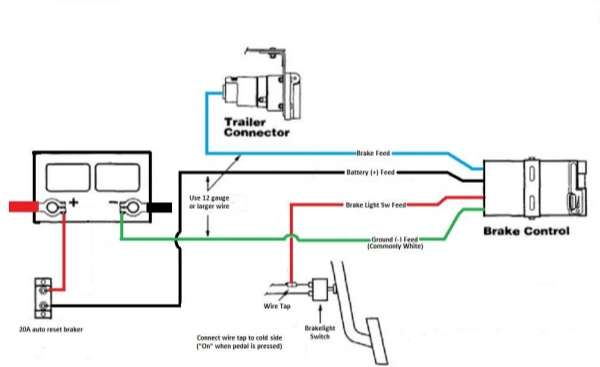
Compatibility between the vehicle and the brake controller is a decisive factor in whether the trailer braking system will function properly. Choosing the wrong controller or using an incompatible wiring configuration can result in brake failure and damage to the vehicle’s electrical system.
A: The type of braking system must match the controller’s activation method
Trailer braking systems fall into two main categories, and the brake controller must correspond to one of them:
- Electromagnetic Braking: The mainstream solution for American-style trailer RVs, where the brake actuator applies force directly to the brake drum via electromagnetic force.
- Electro-hydraulic Braking: An electric signal drives a hydraulic pump, which in turn applies hydraulic pressure to the brake actuator.
Controllers are also divided into two types based on their signal acquisition methods:
Proportional Controller: Features a built-in inertial sensor that detects the towing vehicle’s deceleration in real time and outputs braking force proportionally.
Timed-type controllers: After the brake is applied, they gradually increase output according to a preset time curve without detecting actual deceleration.
If the controller does not match the brake type, the braking system will not function. Before purchasing, you must confirm the specific type of trailer brake and select an appropriate activation method based on frequency of use.
B: Special Requirements and Wiring Specifications for CAN Bus Vehicles
CAN bus vehicles may not have a traditional brake switch signal wire from which to obtain a signal; the controller must parse the brake signal from the CAN bus using a dedicated adapter harness.
Some controllers provide dedicated wiring solutions for CAN bus vehicles; it is recommended to select models that support CAN bus compatibility.
Tip: Before installation, verify whether the vehicle has a pre-installed trailer kit interface. Vehicles with such an interface typically have the CAN signals preconfigured, making installation simpler.
Cost, installation and future-proofing
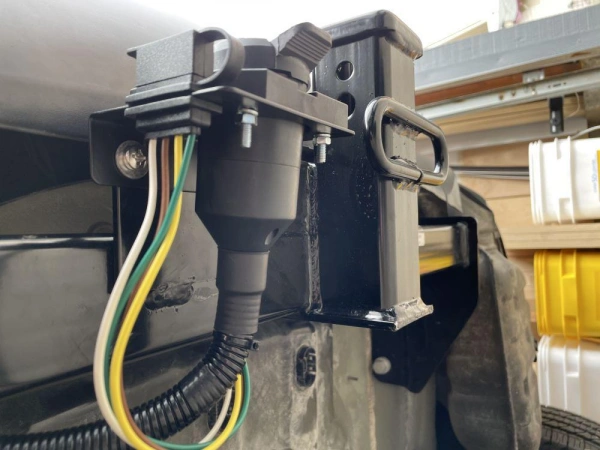
The advantages of the 4-pin connector are its low cost and simple installation; while the 7-pin connector requires a higher initial investment and is more complex to install, it offers more comprehensive functionality and greater expandability. If you plan to upgrade your trailer in the future, the 7-pin connector is a better long-term choice.
| Comparison | 4-Pin Harness | 7-Pin Harness |
|---|---|---|
| Kit Cost | Approx. ¥100–400 ($15–60). Simple and widely compatible. | Approx. ¥350–1,100 ($40–150+). Vehicle-specific and module-equipped kits cost more. |
| Installation Cost | Low. Signals can usually be tapped from the tail lights. | Higher. Requires battery power wiring, circuit protection, and sometimes a control module. |
| DIY Installation | Easy. Simple four-circuit wiring. | Moderate to difficult. May require brake controller and power circuit installation. |
| CAN Bus Compatibility | Usually no additional module required. | May require a dedicated CAN bus control module and vehicle-specific programming. |
| Expansion Capability | Limited. No circuits for electric brakes, auxiliary power, or reverse lights. | Extensive. Supports electric brakes, auxiliary power, and reverse lights. |
| Upgrade Path | Requires full harness replacement if upgraded to a brake-equipped trailer. | More future-proof. Additional equipment can be added without replacing the main harness. |
| Regional Compatibility | Widely used, but connector standards should still be confirmed for the target market. | Standards vary by region. SAE J560 and ISO 11446 are physically different and may require an adapter. |
| Long-Term Maintenance | Low. Fewer circuits and simpler troubleshooting. | Moderate. More circuits, but individual functions can usually be serviced separately. |
Frequently asked questions about 4-pin and 7-pin harnesses
Q1: Can a 7-pin connector charge a trailer battery?
Not necessarily. Some 7-pin systems can provide auxiliary charging or maintain the trailer battery’s charge while driving through an auxiliary power circuit, but the actual charging capacity depends on the vehicle’s electrical system, line voltage drop, fuse protection, and battery management methods; it should not be considered equivalent to a dedicated battery charger.
Q2: Do all 7-pin plugs use the same wiring layout?
They are not the same. Although the American SAE J560, European ISO 1724, and Australian AS 4735 are all referred to as “7-pin,” their pin assignments are completely different. Directly connecting them can cause lighting malfunctions or even short circuits. A dedicated adapter must be used when connecting across different standards.
Q3:Can electric brakes work through a 4-pin plug?
Standard 4-way base lighting connectors typically do not have a separate electronic brake output circuit and therefore cannot directly provide brake control signals to common trailer electronic brake systems. When electronic brakes are required, a connector with a separate brake circuit and a compatible brake controller should be used.
Q4:Is a 7-pin harness better for LED lights?
It’s not that it’s “more suitable,” but rather that it provides a more generous power margin. LED lights have low power consumption, so a 4-pin connector is fully capable of powering them. The advantage of a 7-pin connector is that it provides an additional power channel in scenarios with multiple lights or long wiring harnesses, reducing voltage drop and ensuring stable brightness.
Conclusion: 4 Pin vs 7 Pin Trailer Harness: Functions and Selection
The main difference between 4-pin and 7-pin trailer wiring harnesses lies in their functional configurations. A 4-pin harness meets basic lighting requirements such as taillights, turn signals, brake lights, and grounding, while a 7-pin harness adds features such as electric brakes, auxiliary power, and reverse lighting.
For you, choosing a reliable trailer wiring harness manufacturer is crucial. Stable electrical performance, excellent water resistance and corrosion resistance, reliable terminal connections, and a comprehensive quality control system can minimize installation failures and after-sales issues.
Linkwings is committed to providing stable and reliable trailer wiring harness solutions to customers worldwide, and we continuously optimize product design, connection performance, and production quality. If you are looking for a 4-pin or 7-pin trailer wiring harness, please feel free to contact us at any time for product information and customized solutions.

Nicole
The founder of Linkwings Electronics.
10+ Years Experience | 1000+ Global Projects Completed
Specialized in:
- Custom Wire Harness Assembly
- Automotive & Industrial Cable Harness Manufacturing
- Precision Crimping & Terminal Processing
- OEM / ODM Wire Harness Solutions
Need help with your project?
Let Linkwingselec deliver your next wire harness solution.