
Trailer Wire Harness Color Code for 4-Way and 7-Way Connectors
Home » Trailer Wire Harness Color Code for 4-Way and 7-Way Connectors
The trailer harness is to transmit the circuit signal to the trailer. In order to facilitate installation and maintenance, manufacturers use wires of different colours to distinguish different lines. For 4 cores, its circuit colour is uniform, and you can know what the circuit is for by looking at the colour. There are two sets of different standards for 7 cores. The lines of the same colour may have different functions in the two sets of systems.
Therefore, the safest way is to figure out what kind of function this line wants to achieve first. You can’t just look at the colour, and finally check the position of the needle.
What is the standard trailer wire harness color code?
You can think of the colors on a trailer wire harness as labels for the circuits – a quick way to know what each circuit does. Taking the very common 4-way trailer wire harness in North America as an example:
- White wire: Ground, serves as the negative return path for the entire lighting system.
- Brown wire: Controls tail lights, clearance/marker lights, and license plate lights.
- Yellow wire: Controls the left turn signal and the left brake light.
- Green wire: Controls the right turn signal and the right brake light.
Many people wonder how 4 wires can control so many functions. North American trailers have a design where the brake light and turn signal share the same wire (e.g., yellow and green wires). Therefore, there’s no need for an extra wire dedicated solely to the brake lights.
4-way trailer wiring color code and pin functions
The 4-way flat trailer connector is the simplest for beginners to understand.
It essentially does four things: Ground, Tail/Running Lights, Left Turn/Brake, Right Turn/Brake.
- White: Ground
- Brown: Tail lights, clearance/marker lights
- Yellow: Left turn signal, left brake light
- Green: Right turn signal, right brake light
Here are some practical examples:
- You turn on your vehicle’s clearance/marker lights → The brown wire receives power → The trailer’s tail lights and clearance lights illuminate.
- You activate the left turn signal → The yellow wire receives intermittent power → The trailer’s left turn signal flashes.
- You press the brake pedal → Both the yellow and green wires receive a signal → Both the left and right brake lights on the trailer illuminate.
- So, for common utility trailers, small boat trailers, etc., that only need basic lighting, this 4-way connector is perfectly sufficient.
7-way RV blade color code and pin functions
The 7-way RV blade connector is much more complex than the 4-way. It doesn’t just handle lights; it has four additional functions: electric brakes, 12V auxiliary power, and reverse lights. The complete 7-way connector has 7 circuits responsible for: Ground, Tail/Running Lights, Left Turn/Brake, Right Turn/Brake, Electric Brake Control, 12V Auxiliary Power, and Reverse Lights.
However, the 7-way connector has two different wiring standards, and the colors correspond to different functions.
In the first standard, SAE J2863 (newer standard):
- White: Ground
- Brown: Tail lights, clearance lights
- Yellow: Left turn + Brake
- Green: Right turn + Brake
- Blue: Electric Brake
- Orange: 12V Auxiliary Power
- Gray: Reverse Lights
In the second standard, Traditional RV (older standard), the functions of the white and blue wires remain the same, but the colors of others change:
- Green: Tail lights, clearance lights
- Red: Left turn + Brake
- Brown: Right turn + Brake
- Blue: Electric Brake
- Black: 12V Auxiliary Power
- Yellow: Reverse Lights
So, never assume a green wire is for the right turn signal just because of its color. The same wire color can perform entirely different functions. When repairing or wiring, you cannot rely solely on color.
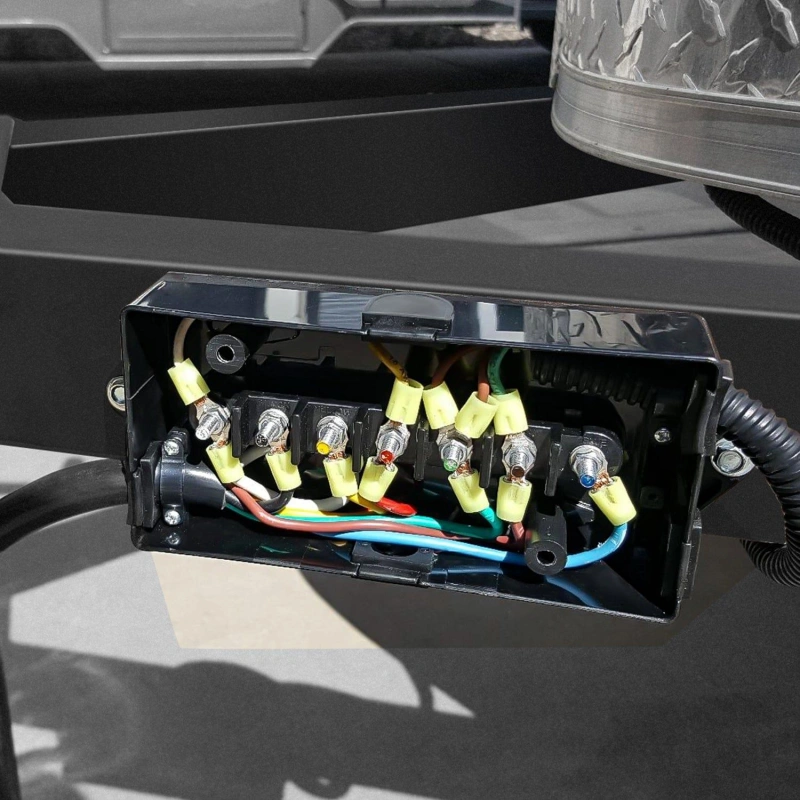
SAE/traditional vs RV trailer wire colors
There’s a common point of confusion here: you must distinguish between the connector type and the wire color standard. Don’t mix them up.
“7‑Way RV Blade” describes only the physical shape of the connector – 6 flat blade contacts on the periphery, plus 1 center contact. “Traditional” and “SAE J2863” define the color of each wire and its corresponding function.
In SAE J2863: Brown = Tail lights, Yellow = Left Turn/Brake, Green = Right Turn/Brake.
In Traditional RV: Green = Tail lights, Red = Left Turn/Brake, Brown = Right Turn/Brake.
Generally, Traditional RV wiring is more common in travel trailers and camping trailers; SAE J2863 is more often found in cargo and utility trailers. However, in practice, you cannot determine wire function simply by assuming “it’s an RV.” That can lead to errors. The safest approach is to check the markings on the connector, consult manufacturer diagrams, or use a test light/multimeter to confirm function.
7-way blade vs 7-way round pin positions
Here’s another easily confused point: 7-way blade and 7-way round pin connectors. Even though both are called “7-way,” you cannot directly connect pin 1 to pin 1, pin 2 to pin 2, etc.
- 7-way Blade: Has 6 flat blade contacts distributed around the outside, plus 1 center contact. The center contact is typically used for reverse lights or auxiliary power. The outer 6 contacts handle Ground, Electric Brake, Tail Lights, 12V Power, Left Turn/Brake, and Right Turn/Brake.
- 7-way Round Pin: Uses round pins. These are mostly found on heavy-duty trucks and commercial trailers. The function assigned to each pin differs from the blade type, and there can be variations depending on the equipment.
Never assume that just because both connectors have 7 pins, you can match pin numbers directly (1 to 1, 2 to 2). That will cause wiring chaos, leading to lighting and brake malfunctions.
If you need to convert from a blade connector to a round pin connector, you must connect by function: Ground to Ground, Brake to Brake, Tail to Tail. Do not simply match wire colors or pin numbers. This is a critical principle.
How do you identify a wire when colors do not match?
If you open up an old trailer and the wire colors don’t match the standard, it doesn’t necessarily mean it was wired incorrectly. Trailer repairs, DIY modifications, and different manufacturers’ parts can all cause color confusion.
Don’t judge a wire by its color; look at the circuit it’s connected to and its actual function. When replacing connectors, use tools to test the wires. Don’t assume the previous person followed standard colors.
If you’re a beginner, follow this order for troubleshooting: Ground → Running/Tail Lights → Left Turn/Brake → Right Turn/Brake → Electric Brake, Reverse, 12V Auxiliary Power. (For 4-pin, only test the first 4; for 7-pin, test the additional functions as well.)
Verify ground before testing signal wires
Trailer lights don’t just rely on positive power; they need a complete circuit (return path) to illuminate. If the ground wire is faulty, testing other circuits will yield incorrect results. For example, activating the left turn signal might cause not only erratic flashing on the left but also dim flickering on other lights. Many assume the turn signal wire is reversed, but often it’s a ground fault. Prioritize checking the ground; don’t rush to rewire signal wires.
With the trailer disconnected from the tow vehicle, use a multimeter set to continuity or resistance to test the connection between the suspected ground wire and the vehicle’s ground point. A good ground wire should show low resistance (good continuity).
Remember, white is commonly ground, but don’t rely solely on color – always test it.
Also, don’t rely on metal-to-metal contact (e.g., through the hitch ball) as the primary ground method. The harness itself should have a dedicated ground wire.
Label both ends before disconnecting an old harness
If you are replacing a still-functioning old harness, don’t cut it all off and then try to figure out the colors online. Make labels before you disconnect anything.
First, determine the actual function of each wire, then label it by function:
- GND: Ground
- TAIL: Running/Tail Lights
- LT/STOP: Left Turn/Brake
- RT/STOP: Right Turn/Brake
- BRAKE: Electric Brake
- REV: Reverse Lights
- +12V: Auxiliary Power
Connect wires by function, not by color. For example, if the old red wire controls the left turn signal, and the new harness uses yellow for the left turn, connect the old red wire to the new yellow wire. Don’t force a red-to-red connection.
Always take photos before disconnecting the connector. Pay attention to whether you are viewing the front (pin side) or the back (wire side) of the connector. The pin layout appears mirrored from the back, which is a common reason for wiring errors.
Common color-code mistakes and their symptoms
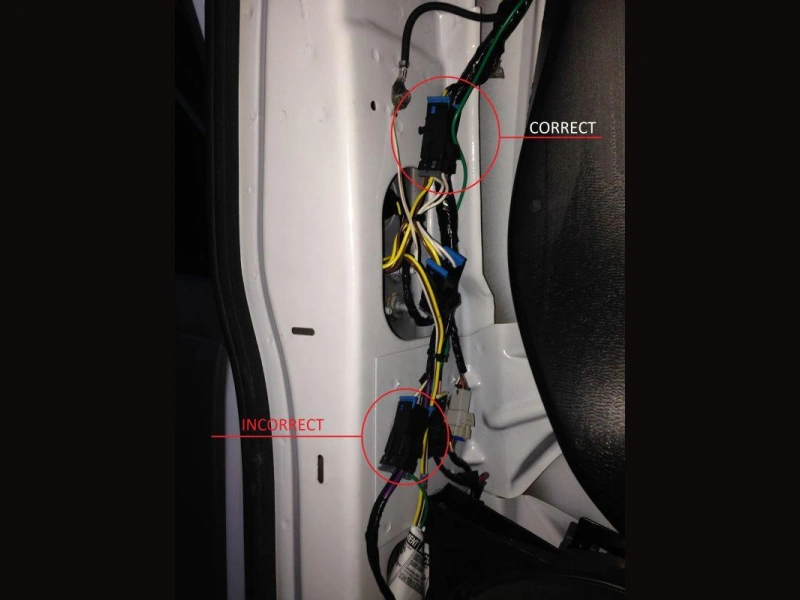
Relying solely on color is risky. If the previous person didn’t follow the standard, and you wire based only on color, you’ll get it all wrong. However, you can often diagnose problems based on symptoms. For example:
- Yellow and Green wires reversed: Activating the left turn signal makes the right side flash, and vice versa. Check the left/right turn circuits.
- Brown wire connected to Turn/Brake circuit: Turning on the headlights causes erratic turn signal or brake light behavior. Check the running light circuit.
- Ground wire wrong or poor connection: Lights are dim, multiple lights flicker or behave erratically. Check the ground circuit.
- Simply matching colors on an old harness: Some lights don’t work, or functions are incorrect. Retest and connect by actual function.
- Viewing the 7-pin connector from the wrong side (front vs. back): Many functions malfunction simultaneously. Distinguish between the front (pin) view and the back (wire) view.
- Electric Brake and Auxiliary Power wires mixed up: Electric brakes fail or engage unexpectedly. Check the brake controller output.
- Reverse wire and other auxiliary wires confused: Shifting into reverse triggers strange, incorrect functions. Check reverse and auxiliary power circuits.
- Treating a “Wishbone” harness as a standard 4-pin: One side’s running lights don’t work. Check the left and right running light branches.
The Wishbone harness is particularly easy to confuse: it appears to have 5 wires, but the connector is still a 4-pin. This is because it simply splits the running light circuit into left and right branches before the connector, but it’s still fundamentally a single running light circuit – not a 5-pin connector.
Frequently asked questions about trailer wire colors
Is white always ground on a trailer?
White is not always ground on a trailer. In North American standard harnesses, white is most often used for ground, especially in 4-pin connectors. However, you cannot assume it’s always ground. Old trailers, repairs, connector replacements, and owner modifications mean a repair person might have used whatever wire was handy.
The correct procedure is: Look at the color → Compare with a wiring diagram → Trace the wire or use a multimeter to test → Determine the function.
In short, while white is frequently ground, always test its actual function before making any wiring changes.
Why are RV and utility trailer colors different?
There isn’t a single, globally mandatory standard for trailer wire colors.
Small utility trailers typically use a 4-pin connector needing only Ground, Running Lights, and Left/Right Turn/Brake lights – usually using the White, Brown, Yellow, Green scheme.
However, RVs and trailers with electric brakes use a 7-pin connector, adding circuits for Electric Brake, 12V Power, and Reverse Lights. With more circuits, different manufacturers developed two different color schemes: one traditional trailer scheme and one RV 7-pin scheme. You’ll encounter both in the market.
Therefore, you can’t use the 4-pin color logic to guess the function of wires in a 7-pin connector. When dealing with a 7-pin connector, identifying the function by the pin position is much more reliable than relying on wire color.
What color is the electric brake wire?
The electric brake wire is most commonly blue. Its operation is straightforward: when you press the brake pedal, the brake controller in the tow vehicle sends a signal through this blue wire, via the 7-pin connector, to activate the trailer’s brakes.
Remember, blue is the most common color, but it’s not 100% guaranteed.
If it’s an old trailer or the wiring has been modified, don’t assume a blue wire is for the brakes just because of its color. Check the pin position on the connector, consult a wiring diagram, and test it with a meter to be certain.
Especially, don’t confuse it with the 12V auxiliary power wire. The 12V wire has constant power; the brake wire only outputs a signal when the brake pedal is pressed. They serve entirely different purposes.
Can wire color identify wire gauge?
No, you cannot determine wire thickness (gauge) by its color. Many beginners mistakenly think a blue wire looks thick, so it must be 12 AWG – this is incorrect. Color indicates the wire’s function, not its thickness. Even two blue wires for brakes from different manufacturers can have different thicknesses.
To find the real wire gauge, look for the printing on the wire insulation, check manufacturer specifications, or examine the actual size of the copper core. Markings like 16 AWG, 12 AWG indicate the true gauge. Colors like Brown, Yellow, Green, Blue, and White do not indicate wire thickness.
Even if two wires have the same function, their gauge may differ. The appropriate wire thickness depends on the current draw of the circuit, wire length, acceptable voltage drop, and the load being powered.

Nicole
The founder of Linkwings Electronics.
10+ Years Experience | 1000+ Global Projects Completed
Specialized in:
- Custom Wire Harness Assembly
- Automotive & Industrial Cable Harness Manufacturing
- Precision Crimping & Terminal Processing
- OEM / ODM Wire Harness Solutions
Need help with your project?
Let Linkwingselec deliver your next wire harness solution.